
Institutional buying refers to large-scale stock purchases made by Foreign Institutional Investors and Domestic Institutional Investors – mutual funds, insurance companies like LIC, pension funds, and foreign portfolio investors. These transactions signal substantial institutional confidence and often precede sustained price moves that retail buying alone cannot sustain.
FIIs – Foreign Institutional Investors, also called FPIs or Foreign Portfolio Investors – are overseas entities investing in Indian equity markets. Global asset managers, sovereign wealth funds, hedge funds, and foreign pension funds all fall into this category. Their flows are sensitive to global risk appetite, currency dynamics, and India-specific macro factors.
DIIs – Domestic Institutional Investors – include Indian mutual funds, insurance companies, and pension funds like EPFO. They represent domestic capital and often act as a counterbalancing force to FII flows – buying when foreign money exits during global risk-off episodes, and sometimes selling when foreign money floods back in.
Both groups matter. When they’re both buying simultaneously, the combined weight of that capital tends to produce particularly strong and sustained price movements.
For a closer look at how foreign and domestic institutions influence Indian markets, see our guide to FII and DII activity.
If the stock eventually moves out of its consolidation range, understanding breakout trading can help investors evaluate the price and volume confirmation behind the move.
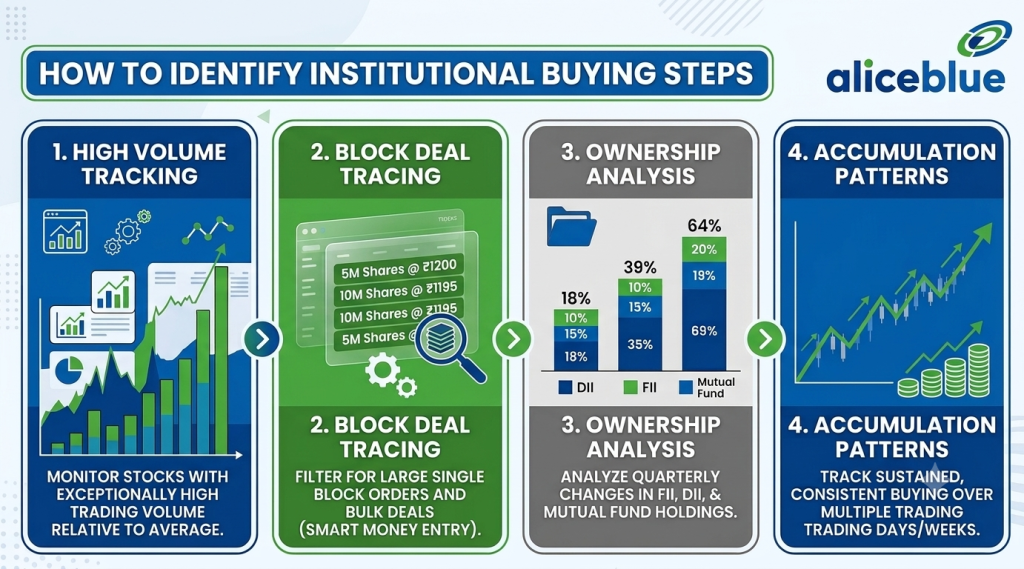
High volume alone doesn’t mean institutional buying. Intraday traders can generate enormous volume without ever taking delivery of shares. What matters is the combination: a volume spike of 3x to 5x the 20-day average, paired with a delivery percentage above 55 to 65%.
High delivery percentage means participants are taking shares into their demat accounts – not squaring off intraday positions. That’s the institutional fingerprint. When you see volume surge and delivery stay consistently above 60%, actual ownership is changing hands in meaningful quantity.
To put a volume spike into context, it also helps to understand how trading volume works and what it can indicate about market activity.
NSE and BSE publish bulk deal and block deal reports daily after market close. These are mandatory disclosures, and they’re publicly accessible.
Bulk deals occur when a single entity buys or sells more than 0.5% of a company’s total listed shares in a single day during regular trading hours. Block deals are single transactions worth a minimum of ₹25 crore, executed in dedicated 15-minute windows at the session open or close, with compulsory delivery settlement. Look for the buyer’s name – specifically for recognised fund houses, AMCs, and foreign institutional names. Repeated net buys by the same institution across consecutive sessions are a particularly strong signal.
Feature | Bulk Deal | Block Deal |
Meaning | Large transaction crossing the applicable disclosure threshold | Large transaction executed through the block-deal mechanism |
Where reported | Exchange disclosures | Exchange disclosures |
Timing | Regular market trading | Designated block-deal window |
What investors can learn | Buyer/seller and transaction details | Buyer/seller and transaction details |
Does it confirm accumulation? | No | No |
SEBI mandates that listed companies disclose their shareholding patterns within 21 days of each quarter’s end. This data is published on NSE and BSE portals and aggregated on platforms like Screener.in and Trendlyne.
What you’re looking for is consecutive quarter-on-quarter increases in FII or DII holding percentages. A single quarter increase could be coincidental. FII holding rising from 3% to 5.5% over two consecutive quarters, while DII holding also increases, is a meaningful pattern suggesting sustained accumulation rather than tactical positioning.
NSE and BSE publish daily provisional cash market trading figures for FIIs and DIIs – typically around 6:30 PM IST. When both FIIs and DIIs show net buying positions across multiple consecutive trading sessions, institutional momentum is active and directional. One day means little. Five consecutive days of net buying from both categories means something.
Where to Track Institutional Buying in Indian Stocks:
Data | Where to check | Frequency |
FII/FPI and DII activity | NSE/BSE | Daily |
Bulk deals | NSE/BSE | Daily |
Block deals | NSE/BSE | Daily |
Shareholding pattern | NSE/BSE/company filings | Quarterly |
Mutual fund holdings | Fund disclosures | Periodic |
Stock fundamentals | Company filings | Periodic |
XYZ Electrics Ltd., a hypothetical mid-cap company, has been consolidating in a ₹200 to ₹210 price range for two months. Then, on a Tuesday, it moves to ₹218 on 4x its average daily volume.
Checking the NSE delivery report reveals a 68% delivery percentage – well above normal for this stock. That evening, NSE publishes a block deal disclosure showing a major domestic mutual fund bought 15 lakh shares at ₹212.
Two quarters later, the company’s quarterly filing shows DII holding increased from 4.2% to 8.7%. The stock, over the following months, moves from ₹218 to ₹310.
The delivery data and block deal disclosure were visible before the breakout. The shareholding change confirmed the accumulation in the quarterly filing. Retail traders who saw the early signals had entry opportunities well before the full move played out.
Parameter | Institutional Accumulation | Retail Buying |
Trade Execution | Spread across days or weeks | Executed instantly in a single order |
Research Foundation | In-depth financial analysis and field checks | News, social media, or short-term tips |
Volume Impact | High volume with heavy delivery (above 55%) | Moderate volume with lower delivery |
Investment Horizon | Medium to long term – 1 to 5 years | Short-term or intraday focused |
Capital Scale | Multi-crore order sizes | Small to moderate positions |
Institutional ownership is only one part of the picture, so investors should also use fundamental analysis to assess a company’s financial health, valuation and business prospects.
A clear stop-loss strategy can help manage downside risk when an institutional-buying thesis does not play out as expected.
Tracking institutional buying isn’t about following the herd – it’s about identifying where deep research and substantial capital are being deployed before the broader market prices in the implications. The signals are public, mandatory, and available for free on exchange portals. Delivery percentages, bulk and block deal disclosures, daily FII/DII flows, and quarterly shareholding changes together form a coherent picture of where smart capital is moving.
That picture doesn’t replace your own analysis. But it provides a powerful filter for focusing research attention on the right names – the ones where institutional conviction is building, not fading.
Daily net buying and selling figures are published every evening after market close – typically around 6:30 PM IST – on the official NSE and BSE websites under the market data section. Both provisional and final figures are available.
A delivery percentage consistently above 50 to 60% alongside a 3x to 5x volume spike generally signals institutional accumulation. Below 50%, the volume is more likely to reflect intraday trading activity.
No. Verify whether the deal was a net buy by a recognised institution, not an intraday arbitrage paired trade. Check the buyer identity disclosed in the filing and see whether the same entity appears across multiple sessions.
Quarterly shareholding patterns are available in the corporate filings section of NSE and BSE portals. Screener.in and Trendlyne aggregate this data in more readable formats and allow filtering for specific holding change thresholds.
Three weeks to several months is the typical range. Institutions buy in controlled batches within a target price range to keep average acquisition costs low. The accumulation phase often ends with a price breakout once sufficient supply has been absorbed.
Bulk deals involve transactions exceeding 0.5% of a company’s total listed shares and occur during regular trading hours. Block deals are single transactions worth at least ₹25 crore, executed in dedicated 15-minute windows at the session open or in the afternoon, with compulsory delivery settlement.
This is common – different institutions operate on different strategic horizons and respond to different triggers. Focus on combined net institutional ownership direction. If total FII plus DII holding grows quarter over quarter despite one group selling, the net institutional bias remains positive.
SEBI mandates that listed companies submit updated shareholding patterns within 21 days of each fiscal quarter’s end – Q1 by July, Q2 by October, Q3 by January, Q4 by April.
Screener.in for custom queries on quarterly institutional holding changes. NSE and BSE portals for daily bulk and block deal reports. Trendlyne for tracking monthly mutual fund portfolio additions and institutional activity timelines across individual stocks.
This is often a strong contrarian signal. If institutions are increasing holdings while price falls, they’re either adding to positions at lower prices – strengthening the thesis – or the market is temporarily mispricing what institutions believe is a quality business. Verify the accumulation is coming from recognised long-term institutions, not arbitrage or short-term players, before drawing conclusions.
Attention Investors!
Stock Brokers can accept securities as margin from clients only by way of pledge in the depository system w.e.f. September 1, 2020. Update your mobile number & email Id with your stock broker/depository participant and receive OTP directly from the depository on your email id and/or mobile number to create a pledge. Pay 20% upfront margin of the transaction early to trade in the cash market segment. Investors may please refer to the Exchange’s Frequently Asked Questions (FAQs) issued vide circular reference NSE/INSP/45191 dated July 31, 2020, and NSE/INSP/45534 dated August 31, 2020, and other guidelines issued from time to time in this regard. Check your Securities /MF/ Bonds in the consolidated account statement issued by NSDL/CDSL every month.
Corporate Office: No. 153/2, 3rd Floor, M.R.B.Arcade, Bagalur Main Road, Dwaraka Nagar, Yelahanka, Bengaluru – 560 063, Karnataka.
Registered Office: Old No.56/2 ,New No.58, LIC Nagar, Vinayagar Kovil Street, Erode -8,Tamil Nadu– 638002.
Alice Blue Financial Services (P) Ltd : NSE EQ | NSE FO | NSE CDS-90112 SEBI REG : INZ000156038
Alice Blue Financial Services (P) Ltd : BSE EQ | BSE FO | BSE CD-6670 SEBI REG : INZ000156038
Alice Blue Financial Services (P) Ltd : CDSL DP ID 12085300 DP SEBI REG : IN-DP-364-2018
Alice Blue Financial Services (P) Ltd : MCX-56710 SEBI REG : INZ000156038
We hereby declare that we are doing PRO trading
Procedure to file a complaint on SEBI SCORES : Register on SEBI SCORES 2.0. Mandatory details for filing complaints on SCORES: Name, PAN, Address, Mobile Number, E-mail ID. Benefits: Effective Communication, Speedy redressal of the grievances
Click on the provided link to learn about the process for submitting a complaint on the ODR platform for resolving investor grievances.
Investment in securities markets are subject to market risks, read all the related documents carefully before investing. Brokerage will not exceed SEBI prescribed limit.
For queries regarding account opening or activation, email to [email protected] and for fund updates, email to [email protected]
Disclaimer : Prevent unauthorized transactions in your account. Update your mobile numbers/email IDs with your stock brokers. Receive information of your transactions directly from Exchange on your mobile/email at the end of the day. Issued in the interest of investors. All clients have to update their email id and mobile number with Member : Investor Grievance [email protected]
KYC is a one time exercise while dealing in securities markets – once KYC is done through a SEBI registered intermediary (broker, DP, Mutual Fund etc.), you need not undergo the same process again when you approach another intermediary.
No need to issue cheques by investors while subscribing to an IPO. Just write the bank account number and sign in the application form to authorise your bank to make payment in case of allotment. No worries for refund as the money remains in the investor’s account.
Investors are requested to note that Alice Blue Financial Services Private Limited is permitted to receive money from investor through designated bank accounts only named as Up streaming Client Nodal Bank Account (USCNBA). Alice Blue Financial Services Private Limited is also required to disclose these USCNB accounts to Stock Exchange. Hence, you are requested to use following USCNB accounts only for the purpose of dealings in your trading account with us. The details of these USCNB accounts are also displayed by Stock Exchanges on their website under “Know/ Locate your Stock Broker. Bank Details (Valid UPI FAQ).


