
Sensex 0DTE by 1LyAlgos sells a Sensex call and a put at the same strike price on expiry day. It enters at 1:00 PM and exits by 3:20 PM, or earlier if the premium drops 30%. The trade makes money when Sensex stays quiet for the rest of the day. Over a 15-month backtest, it won 63.32% of the time and made ₹77,603 on ₹3,20,000 of capital.
Say you check Sensex at 2:45 PM on a Thursday. The index has barely moved all day. That quiet session is exactly what a short straddle is built to profit from. A short straddle means selling both a call option and a put option at the same price level, so you earn money if the market stays flat.
Sensex 0DTE by 1LyAlgos is a strategy built on this idea. It follows fixed rules to sell options on the day they expire and closes the trade the same afternoon. It bets on the market staying calm, not on picking a direction. Below you will see how it works, what it has actually earned in recent months, and where it can hurt you.
0DTE means zero days to expiry. The option contract expires on the same day it is traded. Sensex options currently expire every Thursday on the BSE. So a Sensex 0DTE trade opens and closes within one Thursday session. Nothing is carried overnight.
Sensex 0DTE by 1LyAlgos uses this same-day window to run a short straddle. It sells one call and one put at the same strike price. A strike price is simply the price level at which the option can be exercised. The strategy collects the premium, meaning the price the buyer pays for the option, upfront. It profits if Sensex does not move much before the market closes.
The trade is placed and managed by a program on Alice Blue’s 1LyAlgos platform. This program follows a fixed set of coded rules to decide when to buy or sell, without a person watching the screen live. Alice Blue’s algo trading section and its options trading section on the website explain the basics if you want to read up before trying this.
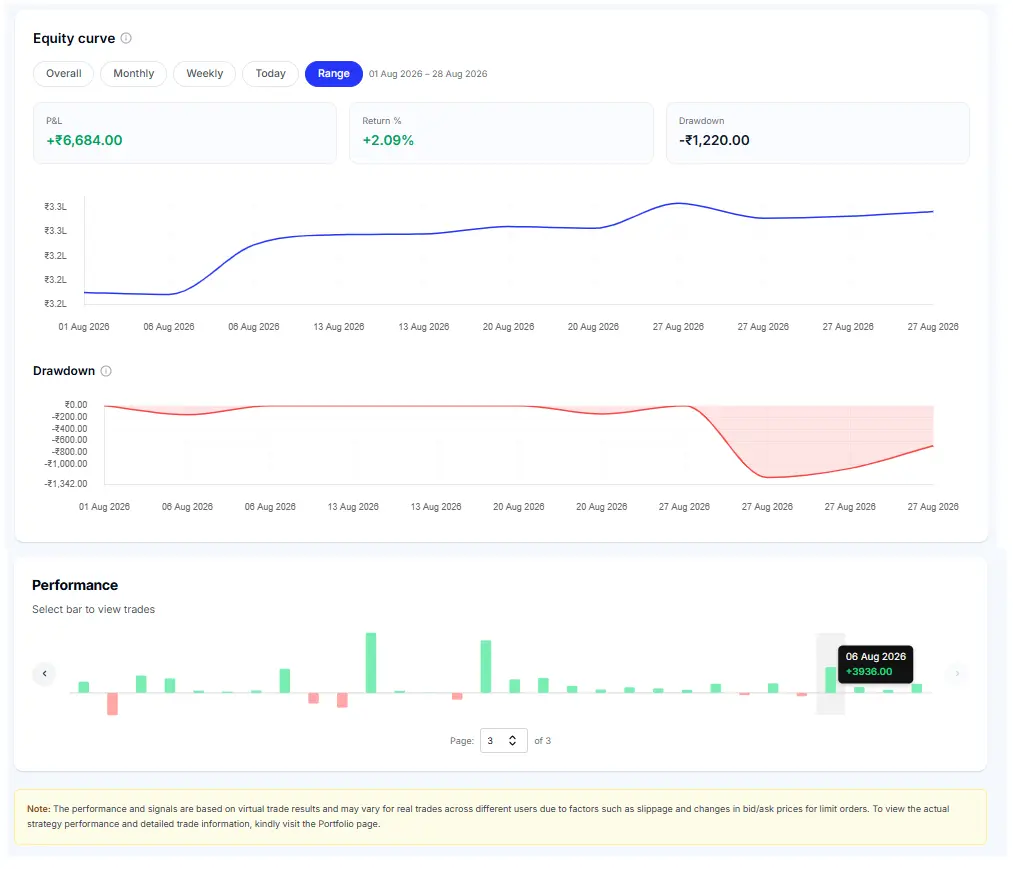
Here is the trade log from the strategy’s factsheet.
Expiry Date | Net P and L |
06 Aug 2026 | plus ₹3,936 |
13 Aug 2026 | plus ₹901 |
20 Aug 2026 | plus ₹466 |
27 Aug 2026 | plus ₹1,381 |
Total (August 2026) | plus ₹6,684 |
On ₹3,20,000 of capital, that works out to about a 2.1% gain for the month. This gain came from four separate trades, not one big bet.
Now zoom out to the full backtest period of 1 year, 3 months, and 10 days. Over that stretch, the strategy shows a 63.32% win rate and made ₹77,603 in net profit on the same ₹3,20,000. In plain terms, roughly 6 out of every 10 Thursdays were profitable. The other 4 were losses that the winning trades had to make up for.
A short straddle with no protection is not the only way to trade a quiet expiry day. Traders who want to limit their downside often switch to a hedged version instead. Here is a plain language look at each one.
Strategy | What It Means | Max Profit | Max Loss | Best For |
Short straddle (this strategy) | Sell a call and a put at the same strike, no protection | Premium collected | Unlimited | Traders okay with unlimited risk |
Short strangle | Same as a straddle, but the call and put strikes are set apart, giving more room before a loss starts | Premium collected | Unlimited, but a wider safety margin | Traders wanting more breathing room |
Iron condor | A short strangle plus one extra option bought on each side to cap the loss | Premium collected minus hedge cost | Capped at a known amount | Beginners wanting a defined risk limit |
Iron butterfly | A short straddle plus one extra option bought on each side to cap the loss | Premium collected minus hedge cost | Capped at a known amount | Traders wanting defined risk in a tight range |
A short straddle collects more premium upfront than its hedged versions. The trade-off is that losses are not capped. Iron condors and iron butterflies buy one extra option on each side specifically to put a ceiling on the loss, even though this slightly reduces the profit. This is usually the next step for traders who find the plain straddle too risky after trying it in small size.
This strategy suits intraday traders who already understand options basics and are comfortable selling premium rather than buying it. It works best for people who want an automatic, rule-based approach and have the margin capital to support it.
It is a poor fit for someone who has never placed an options trade before. A plain short straddle carries a loss potential with no upper limit, which a new trader may not be ready to sit through. It also does not suit traders who strongly believe Sensex will move sharply in one direction, since this strategy is built for the opposite situation. Long-term investors focused on equity or mutual funds have no real use for a same-day expiry strategy like this one.
Sensex 0DTE runs on 1LyAlgos, Alice Blue’s algo trading platform. Ready-made strategies like this one can be subscribed to and run automatically on your account, without writing any code
Sensex 0DTE by 1LyAlgos sells a call and a put on Sensex’s expiry day. It enters at 1:00 PM and exits by 3:20 PM, or on a 30% premium drop. The goal is to profit from a quiet market, not a directional move. Its backtest shows a 63.32% win rate and ₹77,603 net profit on ₹3,20,000 capital over 15 months. August 2026 alone added ₹6,684 across four expiries [file:1]. This strategy works well for traders who understand premium selling and margin. But it carries a loss potential with no upper limit on sharp moves. Do not start it with capital you cannot afford to lose, or without understanding the risk first.
Attention Investors!
Stock Brokers can accept securities as margin from clients only by way of pledge in the depository system w.e.f. September 1, 2020. Update your mobile number & email Id with your stock broker/depository participant and receive OTP directly from the depository on your email id and/or mobile number to create a pledge. Pay 20% upfront margin of the transaction early to trade in the cash market segment. Investors may please refer to the Exchange’s Frequently Asked Questions (FAQs) issued vide circular reference NSE/INSP/45191 dated July 31, 2020, and NSE/INSP/45534 dated August 31, 2020, and other guidelines issued from time to time in this regard. Check your Securities /MF/ Bonds in the consolidated account statement issued by NSDL/CDSL every month.
Corporate Office: No. 153/2, 3rd Floor, M.R.B.Arcade, Bagalur Main Road, Dwaraka Nagar, Yelahanka, Bengaluru – 560 063, Karnataka.
Registered Office: Old No.56/2 ,New No.58, LIC Nagar, Vinayagar Kovil Street, Erode -8,Tamil Nadu– 638002.
Alice Blue Financial Services (P) Ltd : NSE EQ | NSE FO | NSE CDS-90112 SEBI REG : INZ000156038
Alice Blue Financial Services (P) Ltd : BSE EQ | BSE FO | BSE CD-6670 SEBI REG : INZ000156038
Alice Blue Financial Services (P) Ltd : CDSL DP ID 12085300 DP SEBI REG : IN-DP-364-2018
Alice Blue Financial Services (P) Ltd : MCX-56710 SEBI REG : INZ000156038
We hereby declare that we are doing PRO trading
Procedure to file a complaint on SEBI SCORES : Register on SEBI SCORES 2.0. Mandatory details for filing complaints on SCORES: Name, PAN, Address, Mobile Number, E-mail ID. Benefits: Effective Communication, Speedy redressal of the grievances
Click on the provided link to learn about the process for submitting a complaint on the ODR platform for resolving investor grievances.
Investment in securities markets are subject to market risks, read all the related documents carefully before investing. Brokerage will not exceed SEBI prescribed limit.
For queries regarding account opening or activation, email to [email protected] and for fund updates, email to [email protected]
Disclaimer : Prevent unauthorized transactions in your account. Update your mobile numbers/email IDs with your stock brokers. Receive information of your transactions directly from Exchange on your mobile/email at the end of the day. Issued in the interest of investors. All clients have to update their email id and mobile number with Member : Investor Grievance [email protected]
KYC is a one time exercise while dealing in securities markets – once KYC is done through a SEBI registered intermediary (broker, DP, Mutual Fund etc.), you need not undergo the same process again when you approach another intermediary.
No need to issue cheques by investors while subscribing to an IPO. Just write the bank account number and sign in the application form to authorise your bank to make payment in case of allotment. No worries for refund as the money remains in the investor’s account.
Investors are requested to note that Alice Blue Financial Services Private Limited is permitted to receive money from investor through designated bank accounts only named as Up streaming Client Nodal Bank Account (USCNBA). Alice Blue Financial Services Private Limited is also required to disclose these USCNB accounts to Stock Exchange. Hence, you are requested to use following USCNB accounts only for the purpose of dealings in your trading account with us. The details of these USCNB accounts are also displayed by Stock Exchanges on their website under “Know/ Locate your Stock Broker. Bank Details (Valid UPI FAQ).


