
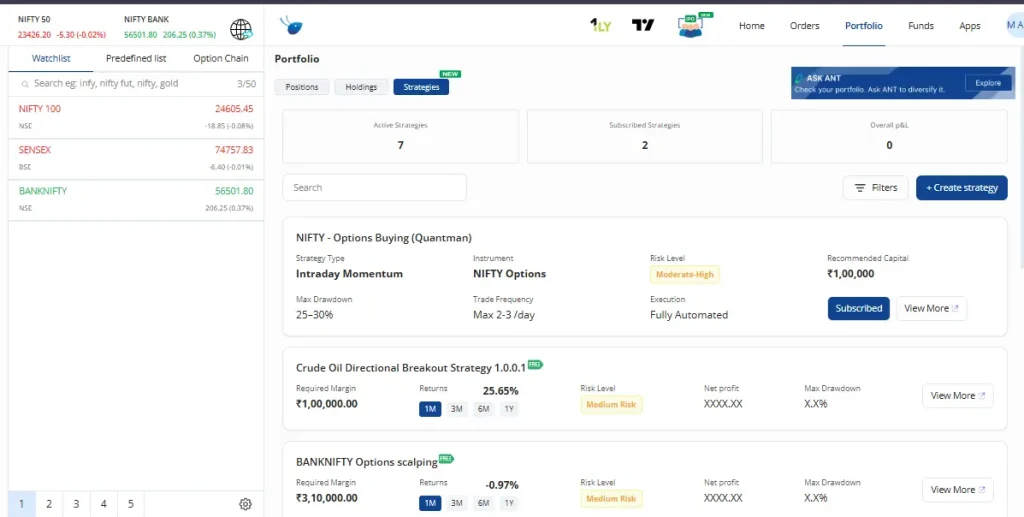
Quantman NIFTY Options Buying is a free algo strategy on Alice Blue’s ANT platform that trades NIFTY options intraday without manual clicks. It watches signals like trend direction and momentum, then buys a Call (CE) or Put (PE) automatically. You need roughly ₹1,00,000 in margin to run it; every trade closes the same day, and it suits traders who want disciplined, rule-based exposure to NIFTY options instead of picking trades themselves.
Ever opened the NIFTY option chain, watched premiums jump in both directions within seconds, and frozen because you couldn’t decide whether to buy a Call or a Put? That hesitation is exactly what Quantman NIFTY Options Buying is built to remove. It’s Alice Blue’s free automated strategy that reads the market and places the trade for you. No manual entry, no second-guessing mid-session. This article covers what it is, how it decides between Call and Put, what it actually earned in a real trading month, and who it’s right for.
Quantman NIFTY Options Buying is a free, rule-based options strategy available on Alice Blue’s ANT trading platform. A computer program tracks NIFTY’s price behaviour through the day, and when its rules match, it buys an option contract for you. You don’t place the order yourself.
An option gives the buyer the right, but not the obligation, to buy or sell NIFTY at a fixed price before a set date. Buy a Call option (CE), and you profit if NIFTY rises. Buy a Put option (PE), and you profit if NIFTY falls. Quantman picks which side to buy after checking the market first, so you’re never the one deciding CE or PE in the moment.
Strategies like this fall under what Alice Blue calls algo trading. Trading run by fixed software rules instead of live human judgement. Two things trip up most NIFTY options beginners: guessing direction correctly, and exiting on time before decay eats the premium. Quantman exists to handle both with the same rules, applied the same way, every trading day.
Here’s how it actually performed in August 2026, based on Alice Blue’s internal tracking:
Metric | Value |
Total trading days | 16 |
Profit days or Loss days | 12 or 4 |
Win rate | 75% |
Total profit (with charges) | ₹14,804.40 |
Best day | +₹3,981.90 (24 Aug 2026) |
Worst day | −₹2,311.00 (21 Aug 2026) |
No-signal days | 5 (excluded from win rate) |
Out of 21 possible trading days, the strategy stayed out on 5 and traded on 16. It won on 12 of those and lost on 4. A 75% win rate for the month, and ₹14,804.40 net profit after charges.
With NIFTY around 23,000 to 24,000 and a lot size of 65 units, a single at-the-money option lot can easily cost several thousand rupees in premium. Add a margin buffer for adverse moves, and ₹1,00,000 with a 1x multiplier gives enough room to take one such position per signal without stretching the account thin. Brokerage, STT (securities transaction tax at 0.15% on options sell side from Budget 2026), and small slippage on execution are the difference between the backtested number and what actually lands in your account. Alice Blue’s own note says backtests don’t fully include these.
Alice Blue is upfront that past performance, including this month’s numbers, doesn’t guarantee future results. Backtests run on minute-by-minute data. Live trades run on second-by-second data. So real-world numbers can shift slightly from what a backtest shows.
Parameter | Quantman (Auto) | Manual NIFTY Options Trading |
Decision making | Algorithm picks CE or PE | Trader decides based on own read of the market |
Time horizon | Intraday only | Intraday or positional, trader’s choice |
Execution speed | Instant, automatic | Depends on how fast the trader reacts |
Emotional impact | Minimal. Rules don’t panic | High, especially for new traders |
Capital required | ₹1,00,000 recommended, 1x multiplier | Varies with strike and lot size chosen |
Monitoring needed | Low. Runs on its own | High. Needs constant chart watching |
Skill building | Limited insight into why a trade fired | Builds independent trading judgement over time |
Best suited for | Hands-off, disciplined exposure | Traders wanting to develop their own edge |
Quantman NIFTY Options Buying fits traders who already know what a NIFTY option is, have the ₹1,00,000 capital ready, and would rather let rules run the trade than pick entries themselves. It’s also a reasonable entry point if you’re exploring algo trading on Alice Blue for the first time and want to watch an automated system in a live market before building anything more advanced.
It’s a poor fit for someone who has never placed a NIFTY options trade and doesn’t yet know terms like Call, Put, premium, or margin. Start with options trading basics first. It also has no role for long-term investors, since every position closes the same day and there’s no delivery-based holding involved.
Quantman NIFTY Options Buying automates the hardest part of trading NIFTY options. Picking a direction and acting fast by scanning market signals and firing off a Call or Put trade through Alice Blue’s ANT platform. Its August 2026 numbers- a 75% win rate and ₹14,804.40 net profit across 16 trading days- show the approach can work, and its 4 loss days show it isn’t risk-free. The real takeaway: this is a disciplined tool for rule-based NIFTY options exposure, not a shortcut past risk. Fund it properly, judge it over a full month, and take the disclaimers as seriously as the profit numbers.
It’s a free automated strategy on Alice Blue’s ANT platform that trades NIFTY options intraday, buying a Call or Put automatically based on the detected market trend.
Alice Blue recommends ₹1,00,000 with a 1x multiplier. Less than that can lead to margin shortfalls while the strategy is live.
It suits beginners who already understand basic options terms and want a hands-off way to trade NIFTY, but it isn’t a substitute for learning how options work first.
No. In August 2026, it traded 16 of 21 days, won on 12, and lost on 4. A 75% win rate, not a 100% one.
When none of its market conditions are met, it stays out rather than force a trade. That happened on 5 days in August 2026.
Attention Investors!
Stock Brokers can accept securities as margin from clients only by way of pledge in the depository system w.e.f. September 1, 2020. Update your mobile number & email Id with your stock broker/depository participant and receive OTP directly from the depository on your email id and/or mobile number to create a pledge. Pay 20% upfront margin of the transaction early to trade in the cash market segment. Investors may please refer to the Exchange’s Frequently Asked Questions (FAQs) issued vide circular reference NSE/INSP/45191 dated July 31, 2020, and NSE/INSP/45534 dated August 31, 2020, and other guidelines issued from time to time in this regard. Check your Securities /MF/ Bonds in the consolidated account statement issued by NSDL/CDSL every month.
Corporate Office: No. 153/2, 3rd Floor, M.R.B.Arcade, Bagalur Main Road, Dwaraka Nagar, Yelahanka, Bengaluru – 560 063, Karnataka.
Registered Office: Old No.56/2 ,New No.58, LIC Nagar, Vinayagar Kovil Street, Erode -8,Tamil Nadu– 638002.
Alice Blue Financial Services (P) Ltd : NSE EQ | NSE FO | NSE CDS-90112 SEBI REG : INZ000156038
Alice Blue Financial Services (P) Ltd : BSE EQ | BSE FO | BSE CD-6670 SEBI REG : INZ000156038
Alice Blue Financial Services (P) Ltd : CDSL DP ID 12085300 DP SEBI REG : IN-DP-364-2018
Alice Blue Financial Services (P) Ltd : MCX-56710 SEBI REG : INZ000156038
We hereby declare that we are doing PRO trading
Procedure to file a complaint on SEBI SCORES : Register on SEBI SCORES 2.0. Mandatory details for filing complaints on SCORES: Name, PAN, Address, Mobile Number, E-mail ID. Benefits: Effective Communication, Speedy redressal of the grievances
Click on the provided link to learn about the process for submitting a complaint on the ODR platform for resolving investor grievances.
Investment in securities markets are subject to market risks, read all the related documents carefully before investing. Brokerage will not exceed SEBI prescribed limit.
For queries regarding account opening or activation, email to [email protected] and for fund updates, email to [email protected]
Disclaimer : Prevent unauthorized transactions in your account. Update your mobile numbers/email IDs with your stock brokers. Receive information of your transactions directly from Exchange on your mobile/email at the end of the day. Issued in the interest of investors. All clients have to update their email id and mobile number with Member : Investor Grievance [email protected]
KYC is a one time exercise while dealing in securities markets – once KYC is done through a SEBI registered intermediary (broker, DP, Mutual Fund etc.), you need not undergo the same process again when you approach another intermediary.
No need to issue cheques by investors while subscribing to an IPO. Just write the bank account number and sign in the application form to authorise your bank to make payment in case of allotment. No worries for refund as the money remains in the investor’s account.
Investors are requested to note that Alice Blue Financial Services Private Limited is permitted to receive money from investor through designated bank accounts only named as Up streaming Client Nodal Bank Account (USCNBA). Alice Blue Financial Services Private Limited is also required to disclose these USCNB accounts to Stock Exchange. Hence, you are requested to use following USCNB accounts only for the purpose of dealings in your trading account with us. The details of these USCNB accounts are also displayed by Stock Exchanges on their website under “Know/ Locate your Stock Broker. Bank Details (Valid UPI FAQ).


