
You have spent months building a position in a stock you believe in. The company is performing well, your gains are real, but the results season is around the corner, and the market feels shaky. You do not want to exit and trigger taxes. You do not want to hold blind either. A protective put is what sits between those two options.
It is an options strategy that puts a hard floor under your stock. You pay a fixed premium, your downside is capped, and your upside stays fully open. This article explains how it works, how to calculate your numbers, and when using it actually makes financial sense for an Indian retail investor.
A protective put is when you own a stock and buy a put option on that same stock. The put gives you the right to sell your stock at a fixed price, called the strike price, before the option expires. If the stock falls below the strike, you exercise the put and sell at the agreed price. If the stock rises, you let the put expire and keep your gains minus the premium paid.
The strategy works like vehicle insurance. You pay a premium hoping you never need it. If an accident happens, the insurance covers your loss. With a protective put, the “accident” is a sharp fall in your stock price, and the put option is the policy.
A married put is the same strategy with one difference: you buy the stock and the put simultaneously. With a protective put, you already own the stock and add the put later. The mechanics, cost, and payoff are identical.
Step 1: You hold a stock and identify a specific risk
A known event is approaching. Quarterly results, a budget announcement, an RBI decision, or a global macro shock. Your long-term view is unchanged, but you are worried about the next few weeks.
Step 2: You buy a put option on that stock
You select a strike price, typically 3 to 8 per cent below the current market price, and pay the premium. No margin is required since you are buying an option, not selling one.
Step 3: One of two things happens at expiry
If the stock falls below the strike price, you exercise the put and sell at the strike regardless of where the stock is actually trading. Your loss is capped. If the stock stays flat or rises, the put expires worthless. You lose only the premium. Your stock gains remain intact.
Key Formulas:
Breakeven = Stock Purchase Price + Premium Paid Per Share
Maximum Loss = (Stock Purchase Price minus Strike Price) + Premium Paid Per Share
These formulas are consistent with the options contract specifications published on the NSE equity derivatives contract specifications page.
Setup:
You own 300 shares of Infosys at ₹1,500 per share. You buy one lot of a ₹1,450 strike put expiring next month at a premium of ₹20 per share.
Premium paid: ₹20 x 300 = ₹6,000
Breakeven: ₹1,500 + ₹20 = ₹1,520 per share
Maximum loss per share: (₹1,500 minus ₹1,450) + ₹20 = ₹70 per share
Payoff at Different Expiry Prices:
Infosys Price at Expiry | Stock P&L (300 shares) | Put Option P&L | Net P&L |
₹1,100 (crash) | minus ₹1,20,000 | +₹1,05,000 | minus ₹21,000 |
₹1,300 (sharp fall) | minus ₹60,000 | +₹45,000 | minus ₹21,000 |
₹1,450 (at strike) | minus ₹15,000 | minus ₹6,000 | minus ₹21,000 |
₹1,500 (no change) | ₹0 | minus ₹6,000 | minus ₹6,000 |
₹1,520 (breakeven) | +₹6,000 | minus ₹6,000 | ₹0 |
₹1,600 (moderate rise) | +₹30,000 | minus ₹6,000 | +₹24,000 |
₹1,800 (strong rally) | +₹90,000 | minus ₹6,000 | +₹84,000 |
The net loss stays fixed at ₹21,000 regardless of how far the stock falls. Without the put, a fall to ₹1,100 would have cost ₹1,20,000.
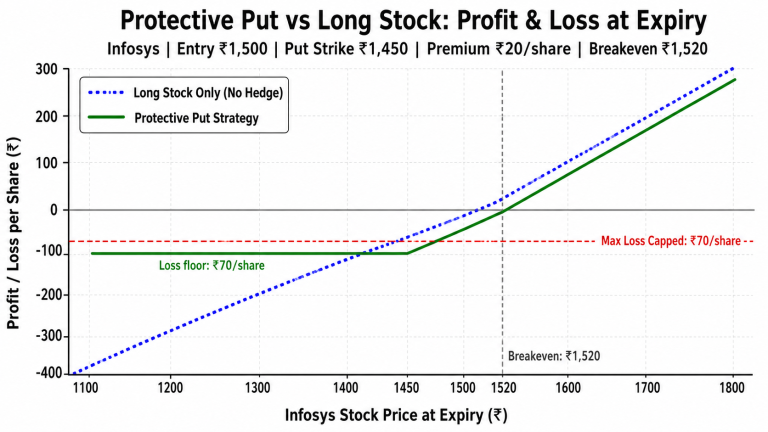
The cost of a put option is directly linked to implied volatility in the market. When India VIX is low, say below 14 to 15, put premiums are cheaper, and protection costs less. When India VIX spikes above 20 to 22 during election results, budget week, or a global sell-off, put premiums can be two to three times their normal price.
The right time to buy insurance is before the risk arrives, not during it. Buying a protective put when India VIX is already elevated means you are paying peak rates for protection at exactly the moment when everyone else wants it too.
Rule of thumb:
India VIX below 15: protective puts are reasonably priced and worth considering.
India VIX above 22: a collar strategy, buying a put while simultaneously selling a call to offset the premium cost, becomes a more practical alternative.
The strike price determines how much protection you get and what you pay for it.
Strike Type | Protection Level | Premium Cost | Best For |
At the Money (ATM) | Protects from the first rupee of fall | Higher | Investors expecting a sharp near-term drop |
Slightly OTM (3 to 5% below) | Protects from moderate falls | Medium | Most common use case for earnings hedges |
Deep OTM (10%+ below) | Only protects against a crash | Very Low | Cheap tail risk insurance only |
A deep OTM put on a ₹1,500 stock with a ₹1,200 strike costs little but only activates after a 20 per cent fall. By that point, you have already lost ₹300 per share. For most retail investors, a strike price 3 to 8 per cent below the current market price offers the best balance of cost and real protection. Understanding options Greeks like Delta and Theta helps with this decision. A put with a Delta of 0.40 to 0.50, which is the ATM range, responds meaningfully to stock price moves and provides real protection against a 5 to 10 per cent correction. A deep OTM put with a Delta of 0.10 barely moves until the stock has already collapsed.
Both aim to limit your downside. But they behave very differently in real market conditions.
Feature | Protective Put | Stop Loss Order |
Type | Options contract | Conditional sell order |
Direct cost | Put the premium paid | No direct cost |
Guaranteed exit price | Yes, at the strike price | No, can slip on gap-down openings |
Overnight crash protection | Fully protected | Executes at whatever price the market opens |
Upside participation | Fully retained | Fully retained |
Can recover value before expiry | Yes, sell the put back | Can be cancelled or modified |
F&O account required | Yes | No |
If a stock closes at ₹2,800 and opens the next morning at ₹2,500 after a sudden news shock, a stop loss placed at ₹2,750 triggers at ₹2,500. A protective put with a ₹2,750 strike pays out at ₹2,750 regardless of what the market does overnight. Learn how stop loss order types work on Alice Blue’s order types support page.
Both strategies involve holding a stock and adding one option leg. But they solve completely different problems.
Protective Put | Covered Call | |
What you do | Buy a put on your stock | Sell a call on your stock |
Why do you use it | Fear of a near-term fall | Want to earn income in a flat market |
Cash impact | You pay a premium | You receive a premium |
Upside | Unlimited | Capped at the call strike price |
Downside | Capped at put strike | Unprotected, only offset by the premium received |
If you are worried the stock will fall in the next month, a protective put is the right tool. If you think the stock will go nowhere and want to earn income from it, sell a covered call instead. Alice Blue’s guide on the covered call strategy explains how to set that up step by step.
The premium you pay for a put option is treated as an F&O transaction by the Income Tax Department, not as a capital expense that gets added to your stock’s cost basis. This is something most Indian investors get wrong.
If the put expires worthless, the premium paid is a business loss under F&O and can be set off against other F&O or business income. It does not reduce your capital gains on the underlying stock.
The stock itself continues under its original capital gains holding period. A long-term investor holding shares for 10 months who uses a protective put does not reset the 12-month LTCG clock by buying a put.
For how F&O losses and turnover are calculated and reported in your ITR, refer to Alice Blue’s article on how to calculate F&O turnover. Always consult a chartered accountant if you are close to the 12-month LTCG threshold before using this strategy.
Well-suited for:
Less suited for:
A protective put does one job cleanly: it puts a hard floor under a stock you want to keep holding. The premium you pay is the price of that certainty. It is not a strategy for every position or every month. It is for specific situations where a known, near-term risk could seriously damage a position you have a genuine conviction in for the long term. Used at the right time, bought when India VIX is low, with a strike price that offers real rather than theoretical protection, it gives Indian retail investors in the F&O segment a way to stay invested without staying exposed.
You own a stock and buy a put option on it. If the stock falls below your chosen strike price, the put lets you sell at that strike and caps your loss. If the stock rises, you lose only the premium paid and keep all your gains.
Breakeven = Stock Purchase Price + Premium Paid Per Share. If you bought the stock at ₹1,500 and paid ₹20 for the put, your breakeven is ₹1,520. The stock must close above ₹1,520 at expiry for the overall position to be net profitable.
Maximum Loss = (Stock Purchase Price minus Strike Price) + Premium Paid. Using the Infosys example: (₹1,500 minus ₹1,450) + ₹20 = ₹70 per share, regardless of how far the stock falls below the strike.
They have the same strategy. In a married put, you buy the stock and the put at the same time. In a protective put, you already own the stock and then add the put later. The payoff, mechanics, and formulas are identical.
Yes. If your portfolio broadly tracks the Nifty 50, buying Nifty put options can protect against a market-wide decline. Use your portfolio beta to calculate how many lots you need. Contract details are available on the NSE equity derivatives contract specifications page.
For all individual stock options on NSE, holding an in-the-money put till expiry triggers mandatory physical settlement as per NSE Circular NSE/INSP/47293. You must deliver shares and will face large additional margin requirements. Always close or roll your position before expiry.
You need your existing demat and trading account with F&O trading activated. Once F&O is enabled on your Alice Blue account, you can access the full options chain for NSE-listed stocks and indices and place protective put orders directly.
Attention Investors!
Stock Brokers can accept securities as margin from clients only by way of pledge in the depository system w.e.f. September 1, 2020. Update your mobile number & email Id with your stock broker/depository participant and receive OTP directly from the depository on your email id and/or mobile number to create a pledge. Pay 20% upfront margin of the transaction early to trade in the cash market segment. Investors may please refer to the Exchange’s Frequently Asked Questions (FAQs) issued vide circular reference NSE/INSP/45191 dated July 31, 2020, and NSE/INSP/45534 dated August 31, 2020, and other guidelines issued from time to time in this regard. Check your Securities /MF/ Bonds in the consolidated account statement issued by NSDL/CDSL every month.
Corporate Office: No. 153/2, 3rd Floor, M.R.B.Arcade, Bagalur Main Road, Dwaraka Nagar, Yelahanka, Bengaluru – 560 063, Karnataka.
Registered Office: Old No.56/2 ,New No.58, LIC Nagar, Vinayagar Kovil Street, Erode -8,Tamil Nadu– 638002.
Alice Blue Financial Services (P) Ltd : NSE EQ | NSE FO | NSE CDS-90112 SEBI REG : INZ000156038
Alice Blue Financial Services (P) Ltd : BSE EQ | BSE FO | BSE CD-6670 SEBI REG : INZ000156038
Alice Blue Financial Services (P) Ltd : CDSL DP ID 12085300 DP SEBI REG : IN-DP-364-2018
Alice Blue Financial Services (P) Ltd : MCX-56710 SEBI REG : INZ000156038
We hereby declare that we are doing PRO trading
Procedure to file a complaint on SEBI SCORES : Register on SEBI SCORES 2.0. Mandatory details for filing complaints on SCORES: Name, PAN, Address, Mobile Number, E-mail ID. Benefits: Effective Communication, Speedy redressal of the grievances
Click on the provided link to learn about the process for submitting a complaint on the ODR platform for resolving investor grievances.
Investment in securities markets are subject to market risks, read all the related documents carefully before investing. Brokerage will not exceed SEBI prescribed limit.
For queries regarding account opening or activation, email to [email protected] and for fund updates, email to [email protected]
Disclaimer : Prevent unauthorized transactions in your account. Update your mobile numbers/email IDs with your stock brokers. Receive information of your transactions directly from Exchange on your mobile/email at the end of the day. Issued in the interest of investors. All clients have to update their email id and mobile number with Member : Investor Grievance [email protected]
KYC is a one time exercise while dealing in securities markets – once KYC is done through a SEBI registered intermediary (broker, DP, Mutual Fund etc.), you need not undergo the same process again when you approach another intermediary.
No need to issue cheques by investors while subscribing to an IPO. Just write the bank account number and sign in the application form to authorise your bank to make payment in case of allotment. No worries for refund as the money remains in the investor’s account.
Investors are requested to note that Alice Blue Financial Services Private Limited is permitted to receive money from investor through designated bank accounts only named as Up streaming Client Nodal Bank Account (USCNBA). Alice Blue Financial Services Private Limited is also required to disclose these USCNB accounts to Stock Exchange. Hence, you are requested to use following USCNB accounts only for the purpose of dealings in your trading account with us. The details of these USCNB accounts are also displayed by Stock Exchanges on their website under “Know/ Locate your Stock Broker. Bank Details (Valid UPI FAQ).


