
El Niño 2026 is shaping up to be more than a weather headline for India. For investors, it is a macro risk that can affect monsoon rainfall, food inflation, rural demand, RBI policy, and sector performance across the market.
That is why this topic matters now. A weak or uneven monsoon can quickly move from farms to food prices, from food prices to inflation, and from inflation to earnings and valuations. In a market like India, where the weather still has a real influence on the economy, El Niño is worth watching closely.
El Niño is a warming pattern in the Pacific Ocean that disrupts normal weather cycles around the world. In India, it often raises the risk of below-normal rainfall during the southwest monsoon.
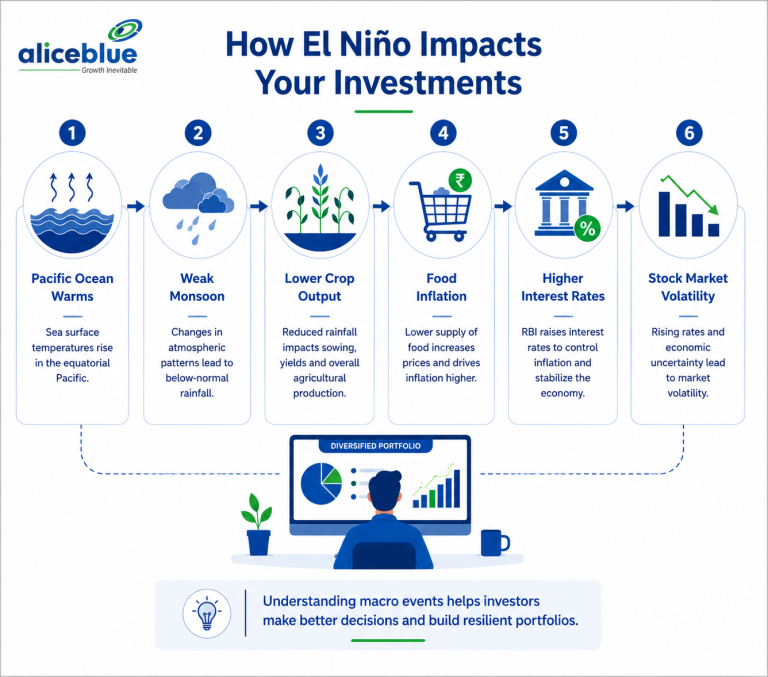
The market link is straightforward:
That chain is what investors should focus on. El Niño is not a direct market event, but it can shape the environment in which markets trade.
The reason this year matters is that several global and Indian forecasts have flagged a meaningful El Niño risk in 2026. The concern is not just that El Niño may appear, but that it may arrive during a season when India is already sensitive to heat, rainfall distribution, and crop planning.
For investors, the important questions are:
A mild El Niño usually creates less market stress. A stronger one can make rainfall uneven, push food prices higher, and trigger sector rotation in the equity market.
India’s economy still depends heavily on the monsoon. A large share of rural income is tied to farm output, and farm output depends on rainfall, water availability, and timing.
When El Niño weakens the monsoon, the impact usually shows up in this order:
This is why El Niño is more than a climate risk. It can become a broad economic risk, especially in a year when food prices and growth are both closely watched.
Why does this matter for listed companies?
Some businesses feel the effect faster than others. A weaker monsoon can change sales trends, margin pressure, and loan demand in sectors that depend on rural India.
For example:
That is where the market starts paying attention.
Food inflation is usually the first macro variable to react when monsoon risk rises. If rainfall is weak, the supply of vegetables, pulses, cereals, and some edible oils can tighten.
That matters for the RBI because the central bank does not react to weather directly, but it does react to inflation trends. If food inflation stays elevated, the RBI is less likely to turn aggressive on rate cuts.
What does this mean for investors?
In simple terms, El Niño can influence both the debt market and the equity market through inflation.
Quick comparison
Area | Possible effect of El Niño | Market takeaway |
Food supply | Lower or uneven output | Higher food inflation risk |
Rural income | Weaker farm cash flows | Softer demand in villages |
RBI policy | More cautious stance | Rate cuts may get delayed |
Bond market | Higher yield pressure | Duration risk can rise |
Not all sectors react the same way. Weather-linked pressure usually hits demand-sensitive and rural-facing businesses first.
Likely pressure areas:
This does not mean these sectors automatically underperform. It means the market may demand stronger earnings visibility before paying premium valuations.
An El Niño year can also create pockets of opportunity. Some sectors gain from heat, water stress, or supply-chain adjustments.
Possible beneficiaries
The point is not that these stocks always go up. The point is that weather stress can shift investor attention toward businesses with defensive earnings or direct demand tailwinds.
Markets dislike uncertainty more than bad news. El Niño creates uncertainty around rainfall, food inflation, and earnings expectations.
That usually leads to a few patterns:
This is why sentiment can change quickly. One weak rainfall update may not matter much on its own, but a consistent pattern of poor distribution can alter the market’s view of the economy.
Rural demand is the key bridge between weather and consumption. If farm income slows, spending decisions become more cautious.
What may happen?
A useful example is this: if a farmer expects lower income because of weak rainfall, he may delay a vehicle purchase, cut back on discretionary items, or postpone home upgrades. Multiply that across rural India, and the demand impact becomes visible.
Commodities often react before earnings do. In an El Niño year, the biggest focus is usually on food commodities, but the impact can extend further.
Main price channels
US example for context
In the US, El Niño often changes winter weather patterns and affects crop expectations, heating demand, and commodity volatility. India’s main channel is different because the monsoon matters much more here, but the market logic is similar: weather shock first, price shock next.
That comparison helps explain why weather risk can become a market risk very quickly.
El Niño does not affect equities alone. It can also shape the bond market and interest-rate outlook.
For bonds:
If food inflation rises, bond yields may remain elevated. That can make duration-heavy debt strategies more sensitive.
For rates:
The RBI is likely to stay cautious if inflation pressure builds. Even if growth remains steady, the central bank may avoid giving aggressive policy support too early.
For earnings:
The impact varies by company:
Yes, sometimes.
The Indian Ocean Dipole, or IOD, can partly offset El Niño if it turns positive. A positive IOD can support rainfall over India and reduce the severity of monsoon weakness.
But this is not a guarantee. If El Niño is strong, the IOD may help only partially. If the IOD also turns favorable, the outcome can improve meaningfully.
The key lesson is simple: do not judge rainfall risk using El Niño alone. India’s weather outcome depends on the broader climate setup.
This is a year for discipline, not panic.
What investors should watch:
Practical approach:
If you are a long-term investor, El Niño is a risk to monitor, not a reason to make emotional portfolio decisions. If you are a sector investor, this is the time to be selective and data-driven.
El Niño 2026 matters because it can affect the full economic chain in India. It can influence rainfall, crops, food prices, rural demand, RBI policy, bond yields, and stock market sentiment.
The main mistake investors make is treating it like a temporary weather headline. It is more than that. It is a macro risk that can alter sector performance and market expectations.
The key variables to track
If El Niño remains moderate, markets may absorb it. If it becomes stronger and rainfall turns uneven, sector rotation and volatility may rise.
No. It increases the risk, but the actual monsoon outcome also depends on other factors like the Indian Ocean Dipole and regional weather conditions.
Rural-demand sectors such as autos, tractors, FMCG, agri-inputs, and rural NBFCs usually see the most attention.
Yes. Lower or uneven crop output can push up food prices, which can lift overall inflation.
Power, cooling products, irrigation, water management, and some staples may benefit depending on demand and pricing conditions.
No. The better approach is to monitor the risk, stay diversified, and watch how earnings and inflation actually evolve.
Attention Investors!
Stock Brokers can accept securities as margin from clients only by way of pledge in the depository system w.e.f. September 1, 2020. Update your mobile number & email Id with your stock broker/depository participant and receive OTP directly from the depository on your email id and/or mobile number to create a pledge. Pay 20% upfront margin of the transaction early to trade in the cash market segment. Investors may please refer to the Exchange’s Frequently Asked Questions (FAQs) issued vide circular reference NSE/INSP/45191 dated July 31, 2020, and NSE/INSP/45534 dated August 31, 2020, and other guidelines issued from time to time in this regard. Check your Securities /MF/ Bonds in the consolidated account statement issued by NSDL/CDSL every month.
Corporate Office: No. 153/2, 3rd Floor, M.R.B.Arcade, Bagalur Main Road, Dwaraka Nagar, Yelahanka, Bengaluru – 560 063, Karnataka.
Registered Office: Old No.56/2 ,New No.58, LIC Nagar, Vinayagar Kovil Street, Erode -8,Tamil Nadu– 638002.
Alice Blue Financial Services (P) Ltd : NSE EQ | NSE FO | NSE CDS-90112 SEBI REG : INZ000156038
Alice Blue Financial Services (P) Ltd : BSE EQ | BSE FO | BSE CD-6670 SEBI REG : INZ000156038
Alice Blue Financial Services (P) Ltd : CDSL DP ID 12085300 DP SEBI REG : IN-DP-364-2018
Alice Blue Financial Services (P) Ltd : MCX-56710 SEBI REG : INZ000156038
We hereby declare that we are doing PRO trading
Procedure to file a complaint on SEBI SCORES : Register on SEBI SCORES 2.0. Mandatory details for filing complaints on SCORES: Name, PAN, Address, Mobile Number, E-mail ID. Benefits: Effective Communication, Speedy redressal of the grievances
Click on the provided link to learn about the process for submitting a complaint on the ODR platform for resolving investor grievances.
Investment in securities markets are subject to market risks, read all the related documents carefully before investing. Brokerage will not exceed SEBI prescribed limit.
For queries regarding account opening or activation, email to [email protected] and for fund updates, email to [email protected]
Disclaimer : Prevent unauthorized transactions in your account. Update your mobile numbers/email IDs with your stock brokers. Receive information of your transactions directly from Exchange on your mobile/email at the end of the day. Issued in the interest of investors. All clients have to update their email id and mobile number with Member : Investor Grievance [email protected]
KYC is a one time exercise while dealing in securities markets – once KYC is done through a SEBI registered intermediary (broker, DP, Mutual Fund etc.), you need not undergo the same process again when you approach another intermediary.
No need to issue cheques by investors while subscribing to an IPO. Just write the bank account number and sign in the application form to authorise your bank to make payment in case of allotment. No worries for refund as the money remains in the investor’s account.
Investors are requested to note that Alice Blue Financial Services Private Limited is permitted to receive money from investor through designated bank accounts only named as Up streaming Client Nodal Bank Account (USCNBA). Alice Blue Financial Services Private Limited is also required to disclose these USCNB accounts to Stock Exchange. Hence, you are requested to use following USCNB accounts only for the purpose of dealings in your trading account with us. The details of these USCNB accounts are also displayed by Stock Exchanges on their website under “Know/ Locate your Stock Broker. Bank Details (Valid UPI FAQ).


