
The Crude Oil Directional Breakout Strategy is an intraday options approach on MCX Crude Oil. It waits for the price to close past a defined range, with rising volume and Open Interest confirming the move, then buys an at-the-money Call or Put option in that direction. The stop loss and target are both set as a fixed percentage of the premium paid, so the maximum loss is known before the trade is placed.
Crude oil sits still for an hour, then suddenly runs hard in one direction. Anyone watching a live MCX chart has seen this happen more than once. The Crude Oil Directional Breakout Strategy is built around that exact moment. It waits for price to close past a known range, checks that volume and Open Interest back the move, then buys a Call or Put option instead of guessing which way things go next. Below is the full mechanism, a worked example with current premium numbers, and where this fits if you are new to options.
It is an intraday options method built on fixed rules. A trader marks a price range on MCX Crude Oil, waits for the price to close beyond that range with volume and Open Interest confirming the move, and then buys an at-the-money option in the breakout direction.
Here is the plain version. Crude oil trades sideways for stretches of time. Traders call this a range. At some point, buyers or sellers push hard enough to break it open. Instead of trading the underlying futures contract directly, this strategy buys a Call option when price breaks upward, or a Put option when it breaks downward. Buying an option instead of trading futures caps the maximum loss at the premium paid, which matters a lot for someone still learning how crude oil moves.
This is a form of price action trading with options layered on top. Decisions come from the chart itself, not a screen full of indicators. Before trying this, it helps to understand the basics of MCX crude oil contracts, including lot size, strike intervals, and expiry, since options behave differently from a straight futures trade.
MCX Crude Oil trades from 9:00 AM to around 11:30 PM IST on most days, extending to 11:55 PM during the period when the US follows daylight saving time. Trading volume tends to build slowly through the day and picks up sharply from around 5:00 PM onward, once European and US markets open and overlap with Indian hours. That evening window is generally when the most reliable breakouts form, since it carries the heaviest volume and Open Interest activity. Be careful around US crude inventory data or OPEC announcements, since implied volatility, a measure of expected price swings that is priced into the premium, can jump sharply during these events even when the underlying price barely moves.
Crude oil futures on MCX were trading close to 8,150 rupees per barrel in the week these figures were checked, with the front month contract seeing an implied volatility of roughly 53 percent. Assume crude oil has been consolidating between 8,100 and 8,150 rupees per barrel for an hour. A candle closes at 8,165 on rising volume, and Call option Open Interest is climbing too, both pointing to a genuine breakout above 8,150.
The ATM Call option, with a strike of 8,200, is trading at a premium of around 430 rupees per barrel. On the Crude Oil Mini options contract, which has a lot size of 10 barrels, that is a total cost of 4,300 rupees for one lot.
Parameter | Value |
Strike, ATM Call | 8,200 |
Entry premium | 430 rupees per barrel |
Lot size, Mini contract | 10 barrels |
Premium cost per lot | 430 multiplied by 10 equals 4,300 rupees |
Stop loss, 30 percent premium drop | Exit near 301, a loss of 129 multiplied by 10 equals 1,290 rupees |
Target, 60 percent premium rise | Exit near 688, a gain of 258 multiplied by 10 equals 2,580 rupees |
If the target is hit, the gain is 2,580 rupees on a risk of 1,290 rupees, close to a 1 to 2 outcome. If the stop is hit, the loss is capped at 1,290 rupees, and it can never go beyond the 4,300 rupees paid as premium, no matter how sharply the breakout fails.
For traders who want the same setup at a larger size, the standard Crude Oil options contract uses a lot size of 100 barrels. The identical trade would cost 43,000 rupees in premium, with a stop loss near 12,900 rupees and a target near 25,800 rupees, ten times the size of the Mini contract example.
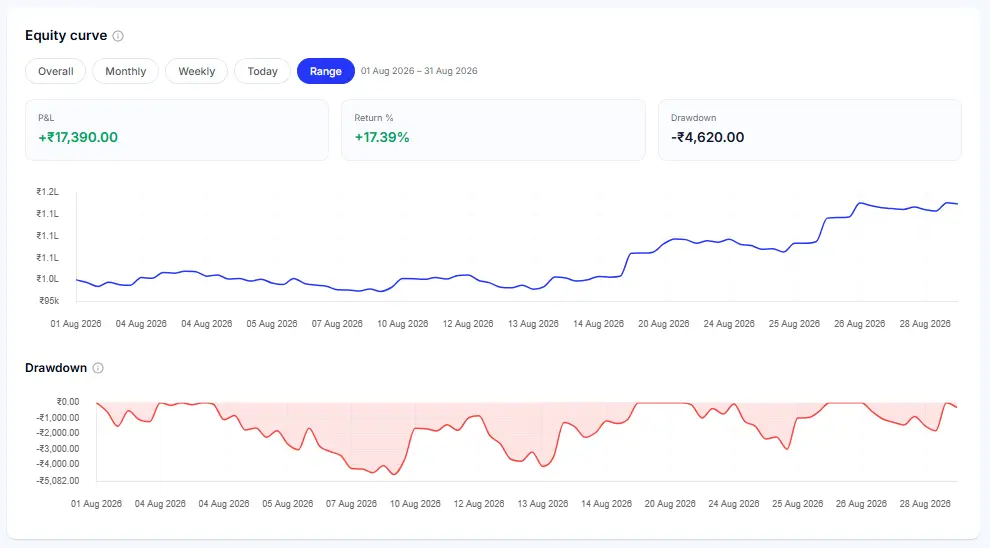
A strategy following this exact structure was tracked on the Alice Blue Algo Trading Marketplace through August, returning 17.39 percent on a capital base of 1,00,000 rupees, around 17,390 rupees in gains, built on breakout confirmed entries with defined risk on every trade. Over its full backtest window of one year, three months, and fourteen days, it held a win rate of 59.51 percent and a net profit of 2,04,800 rupees. These are historical backtest figures, not a guarantee of future performance, and live trading results can differ due to slippage and premium quotes changing between order placement and execution.
Parameter | Options Breakout | Futures Breakout | Range Trading |
Entry point | ATM Call or Put on confirmed breakout | Direct futures position on breakout | Inside the range, near support or resistance |
Maximum loss | Capped at premium paid | Can exceed initial margin if unmanaged | Depends on stop loss placement |
Time decay risk | Yes, premium erodes with time | No | No |
Capital required | Lower, especially with Mini contracts | Higher, based on margin | Similar to futures |
Confirmation needed | Candle close, volume, and OI | Candle close and volume | Support or resistance bounce |
Best suited for | Traders wanting capped risk with defined risk entries | Traders comfortable with margin and open ended downside if unmanaged | Traders comfortable with frequent, smaller moves |
This fits intraday traders who want exposure to crude oil price swings but prefer a capped, known maximum loss over the open ended risk of a futures position. It suits people comfortable reading price charts directly, checking volume and OI together, and following fixed rules rather than discretionary calls.
It is not built for long term investors, since there is no holding period involved. Positions close the same day. It is also not ideal for someone who is not comfortable with how option premiums behave, since a right call on direction can still lose money if time decay or a drop in implied volatility works against the position. Spending time on a demat and trading account with small size practice trades, and understanding basic options behaviour first, is a reasonable step before trading this with meaningful capital.
The Crude Oil Directional Breakout Strategy gives a beginner a fixed, rule-based way to trade MCX crude oil options. Wait for a breakout confirmed by both volume and Open Interest, buy an ATM Call or Put, and manage the exit through a fixed percentage of the premium. The August numbers above show what disciplined execution can look like, but they describe the past, not a promise about what comes next.
What makes this approach usable is not the strategy on paper. It is whether the confirmation steps are followed every time, the stop loss percentage is respected without exception, and the position is closed before time decay eats into it. Capped risk only stays capped if the rules are actually followed.
Yes, mainly because buying options caps the maximum loss at the premium paid, unlike a futures position. Start with the Mini contract and small premium amounts while you learn how fast crude oil premiums move.
It is when price closes clearly past a recent trading range, backed by rising volume and rising Open Interest. That combination signals fresh buying or selling pressure, not just existing positions closing out.
On the Crude Oil Mini options contract, an ATM premium around 430 rupees per barrel costs roughly 4,300 rupees for one lot of 10 barrels. The standard contract, at ten times the size, brings that up to around 43,000 rupees per lot.
MCX Crude Oil trades from 9:00 AM to around 11:30 PM IST, but trading volume builds sharply from around 5:00 PM onward once European and US markets overlap with Indian hours. That evening window usually carries the more reliable breakouts, though premiums can swing sharply around inventory data or OPEC news.
Open Interest is the number of option contracts still open in the market. Rising OI along with rising price suggests new money is entering the trade, which makes a breakout signal more reliable than price movement alone.
Yes. This can happen if implied volatility drops sharply after a news event, sometimes called an IV crush, or if too much time passes and decay eats into the premium. Both are real risks specific to buying options rather than trading futures.
Yes. Since the entry conditions, stop loss percentage, and target percentage are all fixed rules, this kind of setup is well suited to algo trading platforms that can apply the logic without manual monitoring throughout the session.
Attention Investors!
Stock Brokers can accept securities as margin from clients only by way of pledge in the depository system w.e.f. September 1, 2020. Update your mobile number & email Id with your stock broker/depository participant and receive OTP directly from the depository on your email id and/or mobile number to create a pledge. Pay 20% upfront margin of the transaction early to trade in the cash market segment. Investors may please refer to the Exchange’s Frequently Asked Questions (FAQs) issued vide circular reference NSE/INSP/45191 dated July 31, 2020, and NSE/INSP/45534 dated August 31, 2020, and other guidelines issued from time to time in this regard. Check your Securities /MF/ Bonds in the consolidated account statement issued by NSDL/CDSL every month.
Corporate Office: No. 153/2, 3rd Floor, M.R.B.Arcade, Bagalur Main Road, Dwaraka Nagar, Yelahanka, Bengaluru – 560 063, Karnataka.
Registered Office: Old No.56/2 ,New No.58, LIC Nagar, Vinayagar Kovil Street, Erode -8,Tamil Nadu– 638002.
Alice Blue Financial Services (P) Ltd : NSE EQ | NSE FO | NSE CDS-90112 SEBI REG : INZ000156038
Alice Blue Financial Services (P) Ltd : BSE EQ | BSE FO | BSE CD-6670 SEBI REG : INZ000156038
Alice Blue Financial Services (P) Ltd : CDSL DP ID 12085300 DP SEBI REG : IN-DP-364-2018
Alice Blue Financial Services (P) Ltd : MCX-56710 SEBI REG : INZ000156038
We hereby declare that we are doing PRO trading
Procedure to file a complaint on SEBI SCORES : Register on SEBI SCORES 2.0. Mandatory details for filing complaints on SCORES: Name, PAN, Address, Mobile Number, E-mail ID. Benefits: Effective Communication, Speedy redressal of the grievances
Click on the provided link to learn about the process for submitting a complaint on the ODR platform for resolving investor grievances.
Investment in securities markets are subject to market risks, read all the related documents carefully before investing. Brokerage will not exceed SEBI prescribed limit.
For queries regarding account opening or activation, email to [email protected] and for fund updates, email to [email protected]
Disclaimer : Prevent unauthorized transactions in your account. Update your mobile numbers/email IDs with your stock brokers. Receive information of your transactions directly from Exchange on your mobile/email at the end of the day. Issued in the interest of investors. All clients have to update their email id and mobile number with Member : Investor Grievance [email protected]
KYC is a one time exercise while dealing in securities markets – once KYC is done through a SEBI registered intermediary (broker, DP, Mutual Fund etc.), you need not undergo the same process again when you approach another intermediary.
No need to issue cheques by investors while subscribing to an IPO. Just write the bank account number and sign in the application form to authorise your bank to make payment in case of allotment. No worries for refund as the money remains in the investor’s account.
Investors are requested to note that Alice Blue Financial Services Private Limited is permitted to receive money from investor through designated bank accounts only named as Up streaming Client Nodal Bank Account (USCNBA). Alice Blue Financial Services Private Limited is also required to disclose these USCNB accounts to Stock Exchange. Hence, you are requested to use following USCNB accounts only for the purpose of dealings in your trading account with us. The details of these USCNB accounts are also displayed by Stock Exchanges on their website under “Know/ Locate your Stock Broker. Bank Details (Valid UPI FAQ).


