
Sell a near-expiry option, buy a later-expiry option, same strike price for both. That’s a calendar spread. The near option burns off value faster than the far one, so if the underlying just sits still near your strike, you end up ahead. It’s not a strategy for big directional bets, it’s built for markets that go nowhere.
Anyone who’s bought a Nifty option and watched its value drain away by Friday knows the feeling. You were right about direction, maybe, but time still ate your premium. A calendar spread flips that around a bit, you sell the option that’s decaying fast and hold onto one that isn’t, both at the same strike.
This isn’t a complicated trade once you’ve seen it once. Below is how it’s actually built, a Nifty example with real numbers, and the mistakes that trip up most people trying it for the first time.
You sell one option and buy another, same type, same strike, but different expiry dates. Sell the near-week contract, buy something further out, a monthly usually.
Why does this work at all? Because an option expiring in three days loses value at a completely different speed than one expiring in three weeks. That gap in decay speed is basically the entire trade.
There’s a second layer to it that a lot of explanations skip, this is also a volatility play. Near-week options often carry pricier implied volatility right before expiry, and if that cools down, your spread benefits on top of the decay alone. Worth knowing before you assume it’s “just about time.”
One thing people underestimate: you actually need to track theta and vega here, not just price. Theta tells you how fast an option’s losing value from time alone, vega tells you how much it’s reacting to volatility swings.
Nifty’s at 22,500. Here’s what a call calendar spread looks like:
Say Nifty barely moves and settles right around 22,500 when the near leg expires. That short call’s basically dead, worth nothing. Meanwhile your longer-dated call, still a week from expiring, might be sitting at ₹100.
Do the math: (₹100 − ₹80) × 25 = ₹500 profit.
Not huge, but that’s ₹500 on ₹2,000 risked in under a week, and it came from the market doing nothing, which is the whole appeal.
Nifty at near-leg expiry | Short 22500 CE | Long 22500 CE | What happens |
22,500 — stays flat | Nearly worthless | Around ₹100 | Profit near ₹500 |
23,200 — jumps up | Deep in the money | Rises too, gap closes | Loss, capped near ₹2,000 |
21,800 — drops hard | Worthless | Also loses value fast | Loss, capped near ₹2,000 |
Notice the pattern, you want boring, not exciting. A big move either way just narrows the gap between your two legs.
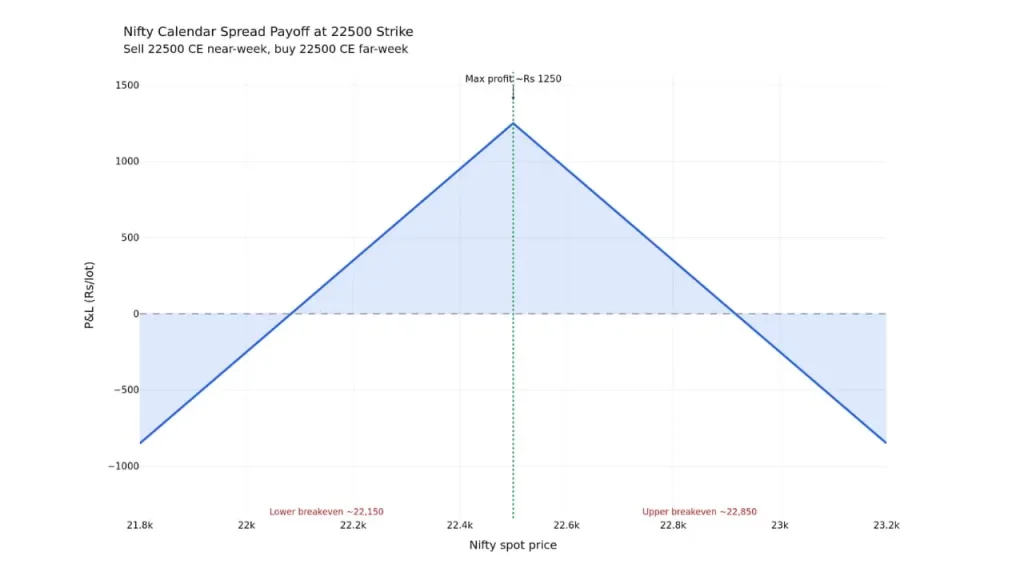
Look at the shape, it’s a hill, not a straight diagonal line. Profit peaks right at the strike and tapers off as price drifts either direction. That hill shape is exactly why there are two breakeven points instead of one.
For our 22500 example, that profitable zone runs roughly from 22,150 to 22,850. Stay inside it, and the long leg’s remaining value covers what you paid. Wander outside it, and you’re heading toward the max loss.
Honestly, glancing at this chart before entering tells you more than any formula, if your expected range for Nifty is wider than that band, skip the trade.
Once your short leg expires, you’re just holding the long option alone. Most people don’t stop there, they sell a fresh near-week option at the same strike and effectively restart the cycle.
Before you roll though, actually check where Nifty’s sitting versus your original strike. If it’s drifted meaningfully, rolling to a new strike closer to current price usually makes more sense than forcing the old one.
Parameter | Calendar Spread | Diagonal Spread |
Strike | Same for both legs | Different strikes |
Expiry | Different | Different |
View needed | Neutral | Slightly directional |
Setup difficulty | Simpler | One more variable to manage |
Works best when | Price stays put | You expect some drift alongside decay |
If you’ve already placed a handful of single-leg option trades and can read an options chain without getting lost, you’re ready for this. It suits people who’d rather define their risk upfront than chase a directional call.
It’s a poor fit if you’re chasing quick intraday wins or you’ve got a strong conviction that Nifty’s about to move sharply. And if you’re a long-term investor who just buys and holds shares, this strategy probably isn’t relevant to your approach at all, it’s built for short-term derivatives trading, not portfolio building.
A calendar spread is really just this: sell the option that’s decaying fast, hold the one that isn’t, same strike, different expiry. It works when the market goes nowhere and falls apart when it doesn’t. Start small on Nifty or Bank Nifty, know your exit before you enter, and stay out of the trade around Budget day or RBI announcements. Once you’ve watched one play out, it stops feeling like theory and starts feeling like a tool you can actually reach for.
It works better once you already know calls, puts, and expiry basics cold. Someone who’s never placed an options trade should build that foundation first.
Yes, same logic, same strike, different expiry, just using puts.
It can be done on individual stocks too, but Nifty and Bank Nifty are usually easier because of better liquidity.
Calendar spread keeps one strike for both legs. Diagonal spread uses two different strikes plus two different expiries.
Right before Budget, RBI policy days, or major earnings, the gap risk isn’t worth it.
Attention Investors!
Stock Brokers can accept securities as margin from clients only by way of pledge in the depository system w.e.f. September 1, 2020. Update your mobile number & email Id with your stock broker/depository participant and receive OTP directly from the depository on your email id and/or mobile number to create a pledge. Pay 20% upfront margin of the transaction early to trade in the cash market segment. Investors may please refer to the Exchange’s Frequently Asked Questions (FAQs) issued vide circular reference NSE/INSP/45191 dated July 31, 2020, and NSE/INSP/45534 dated August 31, 2020, and other guidelines issued from time to time in this regard. Check your Securities /MF/ Bonds in the consolidated account statement issued by NSDL/CDSL every month.
Corporate Office: No. 153/2, 3rd Floor, M.R.B.Arcade, Bagalur Main Road, Dwaraka Nagar, Yelahanka, Bengaluru – 560 063, Karnataka.
Registered Office: Old No.56/2 ,New No.58, LIC Nagar, Vinayagar Kovil Street, Erode -8,Tamil Nadu– 638002.
Alice Blue Financial Services (P) Ltd : NSE EQ | NSE FO | NSE CDS-90112 SEBI REG : INZ000156038
Alice Blue Financial Services (P) Ltd : BSE EQ | BSE FO | BSE CD-6670 SEBI REG : INZ000156038
Alice Blue Financial Services (P) Ltd : CDSL DP ID 12085300 DP SEBI REG : IN-DP-364-2018
Alice Blue Financial Services (P) Ltd : MCX-56710 SEBI REG : INZ000156038
We hereby declare that we are doing PRO trading
Procedure to file a complaint on SEBI SCORES : Register on SEBI SCORES 2.0. Mandatory details for filing complaints on SCORES: Name, PAN, Address, Mobile Number, E-mail ID. Benefits: Effective Communication, Speedy redressal of the grievances
Click on the provided link to learn about the process for submitting a complaint on the ODR platform for resolving investor grievances.
Investment in securities markets are subject to market risks, read all the related documents carefully before investing. Brokerage will not exceed SEBI prescribed limit.
For queries regarding account opening or activation, email to [email protected] and for fund updates, email to [email protected]
Disclaimer : Prevent unauthorized transactions in your account. Update your mobile numbers/email IDs with your stock brokers. Receive information of your transactions directly from Exchange on your mobile/email at the end of the day. Issued in the interest of investors. All clients have to update their email id and mobile number with Member : Investor Grievance [email protected]
KYC is a one time exercise while dealing in securities markets – once KYC is done through a SEBI registered intermediary (broker, DP, Mutual Fund etc.), you need not undergo the same process again when you approach another intermediary.
No need to issue cheques by investors while subscribing to an IPO. Just write the bank account number and sign in the application form to authorise your bank to make payment in case of allotment. No worries for refund as the money remains in the investor’s account.
Investors are requested to note that Alice Blue Financial Services Private Limited is permitted to receive money from investor through designated bank accounts only named as Up streaming Client Nodal Bank Account (USCNBA). Alice Blue Financial Services Private Limited is also required to disclose these USCNB accounts to Stock Exchange. Hence, you are requested to use following USCNB accounts only for the purpose of dealings in your trading account with us. The details of these USCNB accounts are also displayed by Stock Exchanges on their website under “Know/ Locate your Stock Broker. Bank Details (Valid UPI FAQ).


