
A bull put spread means selling a put option at a higher strike and buying another put at a lower strike, both expiring on the same day. You get paid upfront, and that payment is the most you can make on the trade. It’s a good fit when you think the market will hold steady or inch up, not crash.
If you’ve ever sold a put and then spent the whole night worried about how far the market could fall, this strategy solves that problem. You still collect premium, but you cap the damage if things go wrong.
Here’s the setup: you sell a put closer to today’s price and buy a cheaper put further below it. Same stock, same expiry. Since the put you sell costs more than the price you buy, money comes into your account the moment you place the trade. That’s why people call it a credit spread.
You’re betting the market stays above the strike you sold, or at worst dips only a little. If that plays out, both options expire worthless, and you keep what you collected. If the market falls hard, the put you bought stops your losses from running too far.
Most Indian traders run this on Nifty or Bank Nifty because the strikes are liquid and easy to get in and out of. Before you try it, it’s worth spending time on the option chain and understanding how margin gets blocked for a two-leg trade like this.
Break it down like this:
The math is simple once you see it:
Nothing about this trade is a mystery once you’re in it. You know your ceiling and your floor on day one.
Say Nifty is sitting at 24,500.
So you walk away with ₹60 × 75 = ₹4,500 upfront.
Here’s how it plays out at expiry:
Nifty at Expiry | What Happens |
Above 24,400 | Both put die worthless. You keep the full ₹4,500. |
Around 24,340 | This is your breakeven, no gain, no loss. |
Below 24,200 | You’ve hit your max loss, and it doesn’t get worse from here. |
That max loss works out to (24,400 − 24,200 − 60) × 75 = ₹10,500.
So the numbers are clear: ₹4,500 if things go your way, capped at ₹10,500 if they don’t. You’re not chasing a big rally here; you’re betting on the market staying boring.
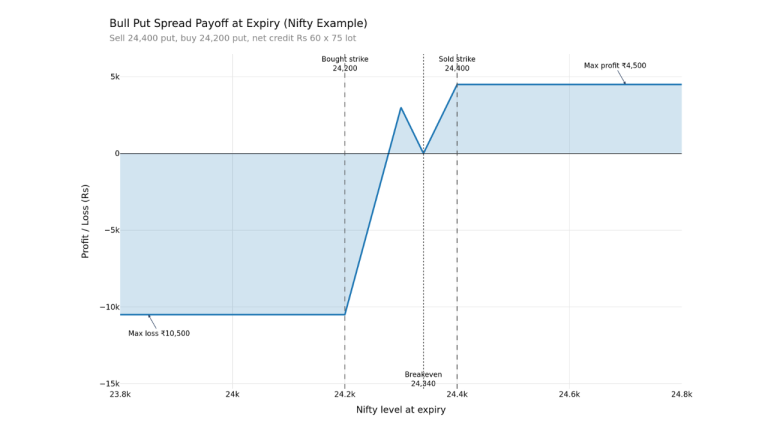
Look at where the line flattens on top; that’s your max profit zone, kicking in once price is above the sold strike. The middle slope is where you’re partially in profit or partially in loss, depending on where the price lands. Once the price drops below the bought strike, the line flattens again at the bottom; that’s your loss, and it stops growing there.
People throw around “Greeks” like everyone’s supposed to already know them. Here’s the plain version:
If you only remember one, remember Theta. Time is on your side in this trade, as long as the market doesn’t do anything dramatic.
The obvious draw is that you get premium income without the open-ended risk of a naked put. If Nifty just sits there going nowhere for a few weeks, this trade can still make money purely from time passing.
It’s also lighter on capital than selling a bare put, since the bought put brings your margin requirement down. And because your max loss is known before you even place the order, sizing the trade sensibly is a lot easier.
Your profit tops out at the premium you collected; no matter how much the market rallies, you don’t get more.
If the market drops below your breakeven, you start losing money, and a sharp fall can take you straight to your max loss. Volatility spikes are another risk; if the market suddenly gets nervous, unwinding the trade can cost more than you expect. And if you pick illiquid strikes, the gap between buy and sell prices can quietly eat into what you’d otherwise keep.
There’s a human risk too; holding on to a losing spread, hoping it turns around, is how a small loss becomes the full loss.
Both are bullish plays, but they work in opposite directions when it comes to cash flow.
Parameter | Bull Put Spread | Bull Call Spread |
Money at entry | You receive it | You pay it |
Best for | Flat to mildly bullish views | Stronger bullish views |
Time decay | Helps you | Works against you |
What you’re really betting on | Premium collection | Actual price movement |
If you’re just trying to earn from a quiet market, go with the put spread. If you actually expect a decent rally, the call spread makes more sense.
A lot of beginners pick the strike closest to the market just because the premium looks juicier. That’s usually a mistake; the closer your sold strike is to spot, the easier it is for the market to breach it.
A saner approach: stick to strikes with decent open interest, keep the bid-ask gap tight, and don’t stretch the spread wider than your view actually supports. If you’re only mildly bullish, don’t get greedy chasing extra premium with a tighter strike.
On exits, don’t feel like you have to hold every trade to expiry. If you’ve already banked 70-80% of the possible profit, it’s often smarter to close out rather than sit through the last few days for a small extra gain.
Don’t run this if you think the market’s about to fall hard. The same goes for going into big events, results season, RBI policy days, or anything that could spike volatility out of nowhere.
Skip it when:
A trade that looks safe on a spreadsheet can still go sideways fast if volatility jumps unexpectedly.
Most of these happen because the strategy looks calm and mathematical on paper. In a live market, discipline matters more than the setup itself.
This works well for people who already understand how options behave and want a way to collect premium without unlimited downside. Active traders and swing traders who track their positions regularly get the most out of it.
It’s not the best starting point if you’ve never traded a single option before, get comfortable with one leg before you manage two. It also doesn’t suit long-term investors who’d rather not check their screen every few days.
In India, profits from options trades usually count as business income, not capital gains. So gains or losses from a bull put spread typically get reported under business income, and how it’s taxed depends on your overall trading activity and income slab.
Keep your trade statements and brokerage charges handy throughout the year. It makes filing a lot less painful when the time comes, especially if you’re trading often.
A bull put spread is a straightforward way to earn premium while knowing exactly what you stand to lose. It shines when the market’s calm or just mildly positive, not when you’re expecting fireworks. Sell the higher strike, buy the lower one, pocket the difference, and have a plan for when to exit. If you’re just starting, keep it small, stick to liquid strikes, and always know your worst case before you place the trade.
Go with strikes that fit your actual market view, not the ones with the fattest premium. Beginners are better off sticking to liquid strikes with solid open interest rather than reaching for extra income.
Not necessarily. If you’ve already captured most of the premium, closing early often makes more sense than risking a late reversal for a small extra gain.
Only once you already understand the basics, strike price, expiry, and premium. If you’ve never traded a single put option, start there first.
Whatever premium you collected at entry. That’s your ceiling, no matter how far the market rallies.
Yes, and honestly, that’s where most people run it, the liquidity makes entering and exiting much smoother than with individual stocks.
Yes, because your loss is capped. The catch is your profit is capped too, you’re trading upside for safety.
Attention Investors!
Stock Brokers can accept securities as margin from clients only by way of pledge in the depository system w.e.f. September 1, 2020. Update your mobile number & email Id with your stock broker/depository participant and receive OTP directly from the depository on your email id and/or mobile number to create a pledge. Pay 20% upfront margin of the transaction early to trade in the cash market segment. Investors may please refer to the Exchange’s Frequently Asked Questions (FAQs) issued vide circular reference NSE/INSP/45191 dated July 31, 2020, and NSE/INSP/45534 dated August 31, 2020, and other guidelines issued from time to time in this regard. Check your Securities /MF/ Bonds in the consolidated account statement issued by NSDL/CDSL every month.
Corporate Office: No. 153/2, 3rd Floor, M.R.B.Arcade, Bagalur Main Road, Dwaraka Nagar, Yelahanka, Bengaluru – 560 063, Karnataka.
Registered Office: Old No.56/2 ,New No.58, LIC Nagar, Vinayagar Kovil Street, Erode -8,Tamil Nadu– 638002.
Alice Blue Financial Services (P) Ltd : NSE EQ | NSE FO | NSE CDS-90112 SEBI REG : INZ000156038
Alice Blue Financial Services (P) Ltd : BSE EQ | BSE FO | BSE CD-6670 SEBI REG : INZ000156038
Alice Blue Financial Services (P) Ltd : CDSL DP ID 12085300 DP SEBI REG : IN-DP-364-2018
Alice Blue Financial Services (P) Ltd : MCX-56710 SEBI REG : INZ000156038
We hereby declare that we are doing PRO trading
Procedure to file a complaint on SEBI SCORES : Register on SEBI SCORES 2.0. Mandatory details for filing complaints on SCORES: Name, PAN, Address, Mobile Number, E-mail ID. Benefits: Effective Communication, Speedy redressal of the grievances
Click on the provided link to learn about the process for submitting a complaint on the ODR platform for resolving investor grievances.
Investment in securities markets are subject to market risks, read all the related documents carefully before investing. Brokerage will not exceed SEBI prescribed limit.
For queries regarding account opening or activation, email to [email protected] and for fund updates, email to [email protected]
Disclaimer : Prevent unauthorized transactions in your account. Update your mobile numbers/email IDs with your stock brokers. Receive information of your transactions directly from Exchange on your mobile/email at the end of the day. Issued in the interest of investors. All clients have to update their email id and mobile number with Member : Investor Grievance [email protected]
KYC is a one time exercise while dealing in securities markets – once KYC is done through a SEBI registered intermediary (broker, DP, Mutual Fund etc.), you need not undergo the same process again when you approach another intermediary.
No need to issue cheques by investors while subscribing to an IPO. Just write the bank account number and sign in the application form to authorise your bank to make payment in case of allotment. No worries for refund as the money remains in the investor’s account.
Investors are requested to note that Alice Blue Financial Services Private Limited is permitted to receive money from investor through designated bank accounts only named as Up streaming Client Nodal Bank Account (USCNBA). Alice Blue Financial Services Private Limited is also required to disclose these USCNB accounts to Stock Exchange. Hence, you are requested to use following USCNB accounts only for the purpose of dealings in your trading account with us. The details of these USCNB accounts are also displayed by Stock Exchanges on their website under “Know/ Locate your Stock Broker. Bank Details (Valid UPI FAQ).


