
Imagine it’s 2 AM, your phone buzzes with a notification from your broker app, and your blue-chip SIP, which you started for your child’s education, is suddenly down 18% in three weeks. You start thinking about the EMIs, the vacation you’ve been saving for, and the retirement that suddenly feels decades away; you start worrying about it, and that sudden fear is caused by a bear market.
Or maybe you’re the analytical type that doesn’t panic easily; you open Excel, pull up the Sensex chart, and start asking yourself, “What separates a healthy bull run from the start of a painful bear phase?”
Whichever side you’re on: emotional investor or data-driven planner? This guide is written for you; we’ll break down bull market vs bear market in simple language, show real Indian examples from Sensex and Nifty, and give you practical strategies that actually work.
A bull market is when stock prices rise 20% or more from their recent lows and stay high for a long period (usually months or years). It’s a market charging forward with high energy, like a bull in a ring.
Key characteristics of a bull market:
In India, bull markets are often powered by domestic retail investors, like you and me, with our SIPs and global money chasing growth. The longest bull run has lasted 3-5+ years because of our young population and structural reforms.
A bear market is the exact opposite, where stock prices fall 20% or more from their recent highs, and the decline lasts for months, making the market feel like it’s hibernating, causing pessimism, fear, and panic selling among investors.
Key characteristics of a bear market:
Bear markets in India are usually shorter, like 9-18 months on average, but feel much longer when your portfolio takes a hit.
Factor | Bull Market | Bear Market |
Price Movement | Rising (20%+ from lows) | Falling (20%+ from highs) |
Investor Sentiment | Optimism, greed, FOMO | Fear, panic, despair |
Average Duration (India) | 2-5+ years | 9-18 months |
Typical Market Return | +80% to +300% | -30% to -60% |
Best Strategy | Buy & hold; ride the wave | SIP aggressively, buy on dips |
Common Triggers (India) | Reforms, rate cuts, and strong GDP | Scams, global crises, inflation |
Impact on SIPs | Wealth creation feels magical | Tests your patience and discipline |
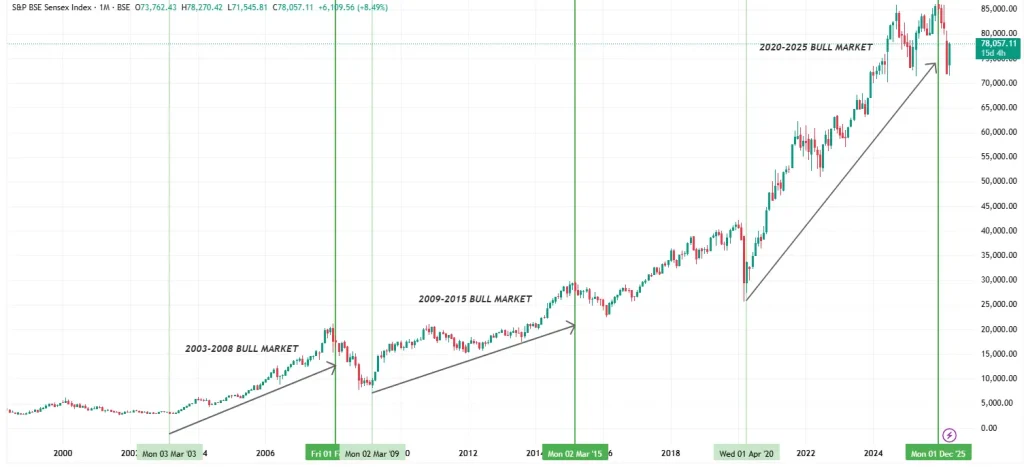
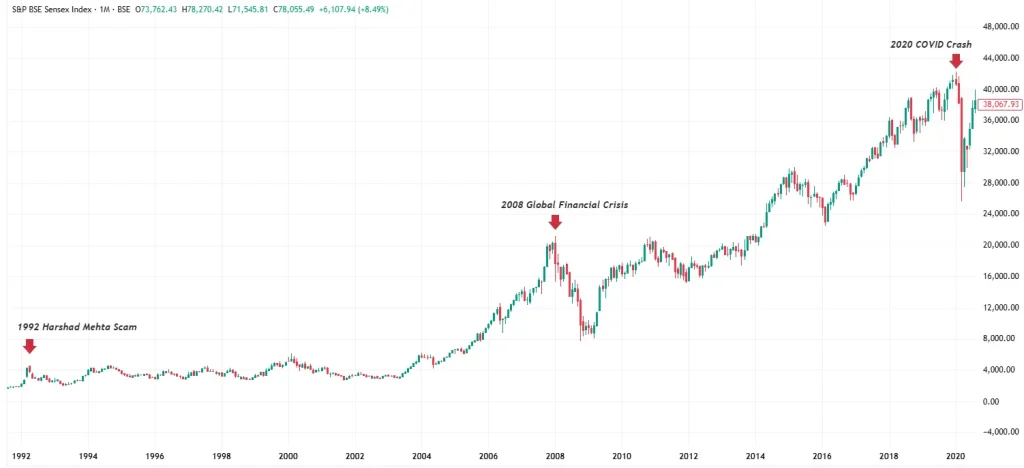
These cycles prove one thing: that every bear market in Indian history has eventually given way to a stronger bull run.
Your mutual fund corpus, PPF, gold, and even real estate all move in tandem with these cycles.
Remember the 2020 COVID crash? Those who continued SIPs through the crash are sitting on life-changing gains today.
In a Bull Market:
In a Bear Market (or correction like now):
Golden Rule: Markets reward time in the market, not timing the market.
As of April 14, 2026, the Sensex is trading around 76,800-77,500, and the Nifty is near 23,800-24,000. We are in a healthy correction after the record high of 86,159 hit in December 2025 (roughly 10-11% off the peak).
This is not yet a full bear market (20%+ drop), but it feels painful after the multi-year rally. Global uncertainties, profit booking, and valuation resets are at play. However, Morgan Stanley and other experts are calling this the potential start of India’s next leg of the bull run, with base-case targets of Sensex 95,000 by December 2026 in a constructive scenario.
Long-term story remains intact: strong GDP, digital India, formalisation, and record SIP inflows. If you’re feeling the emotional pain right now, you’re not alone. But history shows the winners are the ones who stay invested.
Bull markets build wealth, bear markets test character, and the real winners in Indian stock markets are the disciplined SIP investors who treat both phases as normal parts of the journey, just like our real life, with its ups and downs.
Whether you’re staring at your brokerage app at midnight or wondering if your mutual funds are safe, remember, every bear market in India has ended with a stronger bull run.
Market volatility is a constant; however, with the right strategy and a robust platform, every price movement becomes an opportunity. Since selecting a brokerage is foundational to managing costs during market shifts, you can choose to open an Alice Blue Demat account today.
Most Indian bear markets have recovered within 12-24 months and then gone on to deliver even stronger bull runs. The 2020 crash was the fastest recovery in history, showing how resilient domestic flows have made the market.
Foreign Institutional Investors (FIIs) bring big money but can exit quickly during global panic. Domestic Institutional Investors (DIIs) and retail SIP flows have become much stronger since 2020 and often offset FII selling. That domestic power is exactly why Indian bull runs now last longer than in many other countries.
High inflation usually triggers bear phases because the RBI raises interest rates to control it, slowing corporate growth. Moderate inflation with strong GDP growth is ideal for bull markets, and that sweet spot is what powered the 2020-2025 rally.
In the late stage of a bull market, gradually shift 10-20% towards debt or gold for safety. During a bear market or correction, keep your equity SIPs running but increase allocation to defensive sectors and maintain a 12-month emergency fund in liquid assets. The goal is to protect capital while still participating in the next bull run.
Attention Investors!
Stock Brokers can accept securities as margin from clients only by way of pledge in the depository system w.e.f. September 1, 2020. Update your mobile number & email Id with your stock broker/depository participant and receive OTP directly from the depository on your email id and/or mobile number to create a pledge. Pay 20% upfront margin of the transaction early to trade in the cash market segment. Investors may please refer to the Exchange’s Frequently Asked Questions (FAQs) issued vide circular reference NSE/INSP/45191 dated July 31, 2020, and NSE/INSP/45534 dated August 31, 2020, and other guidelines issued from time to time in this regard. Check your Securities /MF/ Bonds in the consolidated account statement issued by NSDL/CDSL every month.
Corporate Office: No. 153/2, 3rd Floor, M.R.B.Arcade, Bagalur Main Road, Dwaraka Nagar, Yelahanka, Bengaluru – 560 063, Karnataka.
Registered Office: Old No.56/2 ,New No.58, LIC Nagar, Vinayagar Kovil Street, Erode -8,Tamil Nadu– 638002.
Alice Blue Financial Services (P) Ltd : NSE EQ | NSE FO | NSE CDS-90112 SEBI REG : INZ000156038
Alice Blue Financial Services (P) Ltd : BSE EQ | BSE FO | BSE CD-6670 SEBI REG : INZ000156038
Alice Blue Financial Services (P) Ltd : CDSL DP ID 12085300 DP SEBI REG : IN-DP-364-2018
Alice Blue Financial Services (P) Ltd : MCX-56710 SEBI REG : INZ000156038
We hereby declare that we are doing PRO trading
Procedure to file a complaint on SEBI SCORES : Register on SEBI SCORES 2.0. Mandatory details for filing complaints on SCORES: Name, PAN, Address, Mobile Number, E-mail ID. Benefits: Effective Communication, Speedy redressal of the grievances
Click on the provided link to learn about the process for submitting a complaint on the ODR platform for resolving investor grievances.
Investment in securities markets are subject to market risks, read all the related documents carefully before investing. Brokerage will not exceed SEBI prescribed limit.
For queries regarding account opening or activation, email to [email protected] and for fund updates, email to [email protected]
Disclaimer : Prevent unauthorized transactions in your account. Update your mobile numbers/email IDs with your stock brokers. Receive information of your transactions directly from Exchange on your mobile/email at the end of the day. Issued in the interest of investors. All clients have to update their email id and mobile number with Member : Investor Grievance [email protected]
KYC is a one time exercise while dealing in securities markets – once KYC is done through a SEBI registered intermediary (broker, DP, Mutual Fund etc.), you need not undergo the same process again when you approach another intermediary.
No need to issue cheques by investors while subscribing to an IPO. Just write the bank account number and sign in the application form to authorise your bank to make payment in case of allotment. No worries for refund as the money remains in the investor’s account.
Investors are requested to note that Alice Blue Financial Services Private Limited is permitted to receive money from investor through designated bank accounts only named as Up streaming Client Nodal Bank Account (USCNBA). Alice Blue Financial Services Private Limited is also required to disclose these USCNB accounts to Stock Exchange. Hence, you are requested to use following USCNB accounts only for the purpose of dealings in your trading account with us. The details of these USCNB accounts are also displayed by Stock Exchanges on their website under “Know/ Locate your Stock Broker. Bank Details (Valid UPI FAQ).


