
Options can be sold as well as bought, and selling them is one way traders in India generate monthly cash flow from the market instead of only buying and hoping for a big move. This blog explains four strategies used for this purpose: covered calls, bull put spreads, iron condors, and short strangles, along with how each one works and the numbers behind them. This content is for educational purposes only and does not constitute investment advice or a recommendation to trade any specific strategy.
Covered calls, bull put spreads, iron condors, and short strangles are four strategies commonly used in India for monthly option income. Covered calls are typically used by people who already hold stock or Nifty futures, while bull put spreads and iron condors function as standalone trades with a known maximum loss. Market participants often track India VIX when choosing between these setups, since VIX below 15 usually reflects a calmer market, while readings above 20 reflect higher expected movement.
Buying an option is a bet on a big price move. Selling one works differently; the seller gets paid upfront, called a premium, and profits if the market stays flat or moves only slightly. That premium lands in the seller’s account the moment the option is sold.
Most options expire worthless, which is the mechanical reason this approach exists. Each day that passes without a large move reduces the option’s value, a process known as time decay, and it forms the basis of every strategy described here.
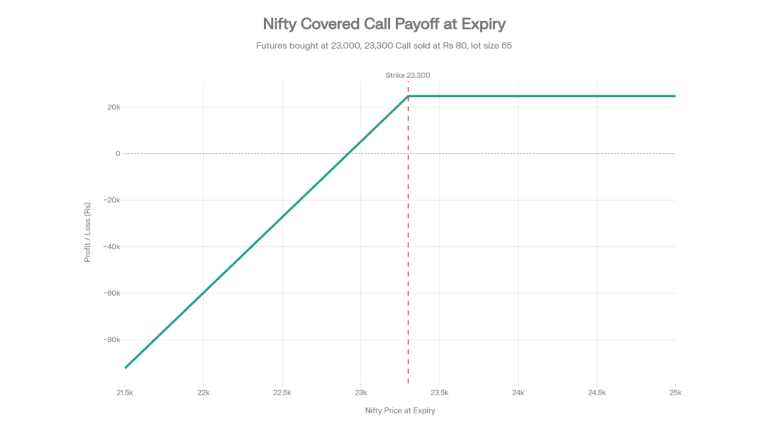
Covered Call: An investor who already owns the stock or Nifty futures sells a call option against that position.
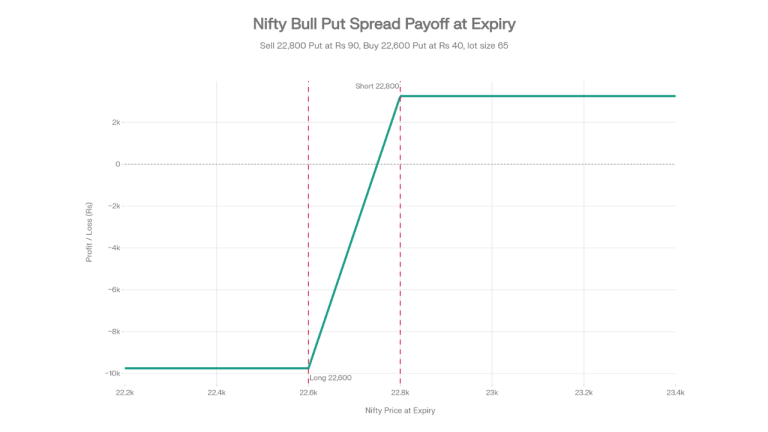
Bull Put Spread: A put is sold, and a cheaper put further away is bought as a hedge.
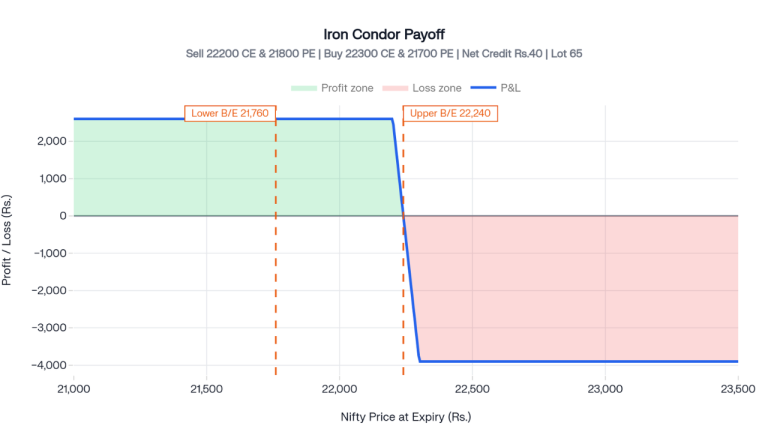
Iron Condor: A four-leg, non-directional structure that works when the price stays within a range.
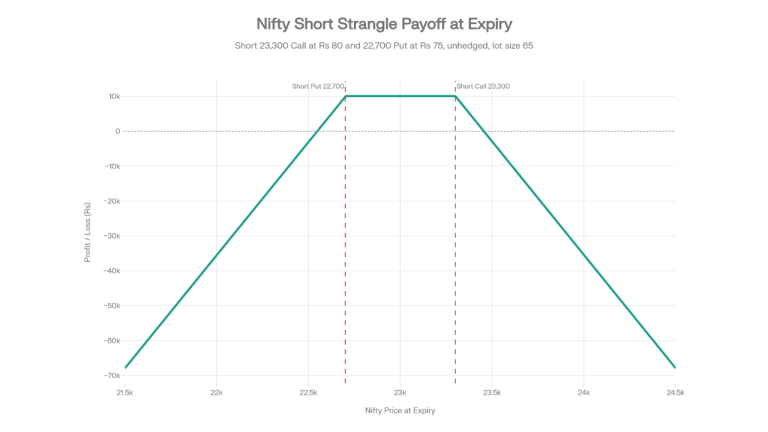
Short Strangle: Structurally similar to the condor but without the protective legs, resulting in a higher premium and higher risk.
NSE revised the Nifty 50 lot size to 65 units, effective from the January 27, 2026, monthly expiry, down from 75.
In this illustration, Nifty futures are held at 23,000, and the 23,300 Call, 300 points away, is sold for a premium of Rs 80 per unit. With a lot size of 65, the premium collected works out to 80 multiplied by 65, which equals Rs 5,200 for that month.
If Nifty stays below 23,300 at expiry, the call expires worthless, and the full Rs 5,200 premium is retained, along with any gain on the futures position. If Nifty rises above 23,300, the futures gain stops growing at 300 points, which is 300 multiplied by 65, or Rs 19,500. Adding the Rs 5,200 premium brings the total to Rs 24,700 in this scenario. These figures are illustrative and depend on actual market prices at the time of the trade.
India VIX is NSE’s volatility index. It reflects how much movement the market expects in Nifty 50 over the next 30 days, calculated from Nifty options prices. Regulatory oversight of exchange-traded derivatives, including index options, sits with the Securities and Exchange Board of India (SEBI), which issues periodic circulars covering derivatives risk management and position limits. A reading below 15 generally reflects a calmer market, 15 to 20 is considered a normal range, and above 20 typically reflects a nervous market or an approaching event such as a Budget or RBI policy meeting. It measures expected movement, not direction.
These structures generate income during periods when the market moves little, which covers a large portion of most calendar years. For existing stockholders, a covered call effectively monetises the unused upside on a position, which lowers the effective holding cost.
A sharp move can result in a loss larger than the premium collected, particularly in an unhedged strangle. A covered call also means gains beyond the strike price are not captured; a 500-point Nifty rally, for example, would only be partially captured.
What matters | Covered Call | Iron Condor |
Requires holding stock or futures | Yes | |
Maximum loss | Not fixed, tied to the underlying position | |
Market condition, it fits | Flat to mildly rising | Range-bound, low VIX environments |
Legs involved | One additional leg on an existing position | Four legs |
Typical use case | Traders already holding stock or futures | Traders without an existing holding seeking defined risk |
These strategies are generally used by traders who are already familiar with basic options terminology, allocate separate trading capital, and are able to check positions on a regular basis. Existing holders of stock or index positions commonly use covered calls as an income overlay on those holdings.
Traders who cannot monitor the market regularly, or who find volatile sessions stressful, may find these structures harder to manage, since they require attention, particularly in the final week before expiry. Long-term investors focused primarily on SIP-based wealth accumulation typically do not use this category of strategy.
Monthly option income in India is generated through structures like covered calls, bull put spreads, iron condors, and short strangles, each suited to a different market condition. No single structure works across every market phase, and traders often move between them based on prevailing volatility, frequently referencing India VIX as one input. Outcomes depend on risk management practices and market conditions at the time of each trade, and past patterns do not guarantee future results.
Defined risk structures like bull put spreads and iron condors have a known maximum loss, which differs from naked strangles, where the loss is not capped. Understanding margin requirements and having an exit plan are commonly cited prerequisites before entering such trades.
This depends on capital deployed, strike selection, and prevailing volatility, and there is no fixed or assured outcome. Losing months can offset gains from winning months depending on market conditions.
Iron condors and bull put spreads have a fixed maximum loss due to the hedge leg, whereas naked selling does not. Covered calls carry risk tied to the underlying position itself.
Yes, NSE revised the Nifty 50 lot size from 75 to 65 units, effective from the January 27, 2026, monthly expiry, with Bank Nifty moving from 35 to 30 units.
Yes, a hedge caps the maximum loss but does not eliminate it. If the price moves beyond the protective strike, the maximum loss built into the structure is realised.
A covered call requires holding the underlying stock or futures, while an iron condor is a standalone options structure that does not require holding anything. Their risk profiles and margin requirements also differ, as detailed in the comparison table above.
Weekly review is common, with more frequent monitoring in the final week before expiry due to increased price sensitivity. Adjustments made closer to expiry are generally considered harder to execute effectively.
Attention Investors!
Stock Brokers can accept securities as margin from clients only by way of pledge in the depository system w.e.f. September 1, 2020. Update your mobile number & email Id with your stock broker/depository participant and receive OTP directly from the depository on your email id and/or mobile number to create a pledge. Pay 20% upfront margin of the transaction early to trade in the cash market segment. Investors may please refer to the Exchange’s Frequently Asked Questions (FAQs) issued vide circular reference NSE/INSP/45191 dated July 31, 2020, and NSE/INSP/45534 dated August 31, 2020, and other guidelines issued from time to time in this regard. Check your Securities /MF/ Bonds in the consolidated account statement issued by NSDL/CDSL every month.
Corporate Office: No. 153/2, 3rd Floor, M.R.B.Arcade, Bagalur Main Road, Dwaraka Nagar, Yelahanka, Bengaluru – 560 063, Karnataka.
Registered Office: Old No.56/2 ,New No.58, LIC Nagar, Vinayagar Kovil Street, Erode -8,Tamil Nadu– 638002.
Alice Blue Financial Services (P) Ltd : NSE EQ | NSE FO | NSE CDS-90112 SEBI REG : INZ000156038
Alice Blue Financial Services (P) Ltd : BSE EQ | BSE FO | BSE CD-6670 SEBI REG : INZ000156038
Alice Blue Financial Services (P) Ltd : CDSL DP ID 12085300 DP SEBI REG : IN-DP-364-2018
Alice Blue Financial Services (P) Ltd : MCX-56710 SEBI REG : INZ000156038
We hereby declare that we are doing PRO trading
Procedure to file a complaint on SEBI SCORES : Register on SEBI SCORES 2.0. Mandatory details for filing complaints on SCORES: Name, PAN, Address, Mobile Number, E-mail ID. Benefits: Effective Communication, Speedy redressal of the grievances
Click on the provided link to learn about the process for submitting a complaint on the ODR platform for resolving investor grievances.
Investment in securities markets are subject to market risks, read all the related documents carefully before investing. Brokerage will not exceed SEBI prescribed limit.
For queries regarding account opening or activation, email to [email protected] and for fund updates, email to [email protected]
Disclaimer : Prevent unauthorized transactions in your account. Update your mobile numbers/email IDs with your stock brokers. Receive information of your transactions directly from Exchange on your mobile/email at the end of the day. Issued in the interest of investors. All clients have to update their email id and mobile number with Member : Investor Grievance [email protected]
KYC is a one time exercise while dealing in securities markets – once KYC is done through a SEBI registered intermediary (broker, DP, Mutual Fund etc.), you need not undergo the same process again when you approach another intermediary.
No need to issue cheques by investors while subscribing to an IPO. Just write the bank account number and sign in the application form to authorise your bank to make payment in case of allotment. No worries for refund as the money remains in the investor’s account.
Investors are requested to note that Alice Blue Financial Services Private Limited is permitted to receive money from investor through designated bank accounts only named as Up streaming Client Nodal Bank Account (USCNBA). Alice Blue Financial Services Private Limited is also required to disclose these USCNB accounts to Stock Exchange. Hence, you are requested to use following USCNB accounts only for the purpose of dealings in your trading account with us. The details of these USCNB accounts are also displayed by Stock Exchanges on their website under “Know/ Locate your Stock Broker. Bank Details (Valid UPI FAQ).


