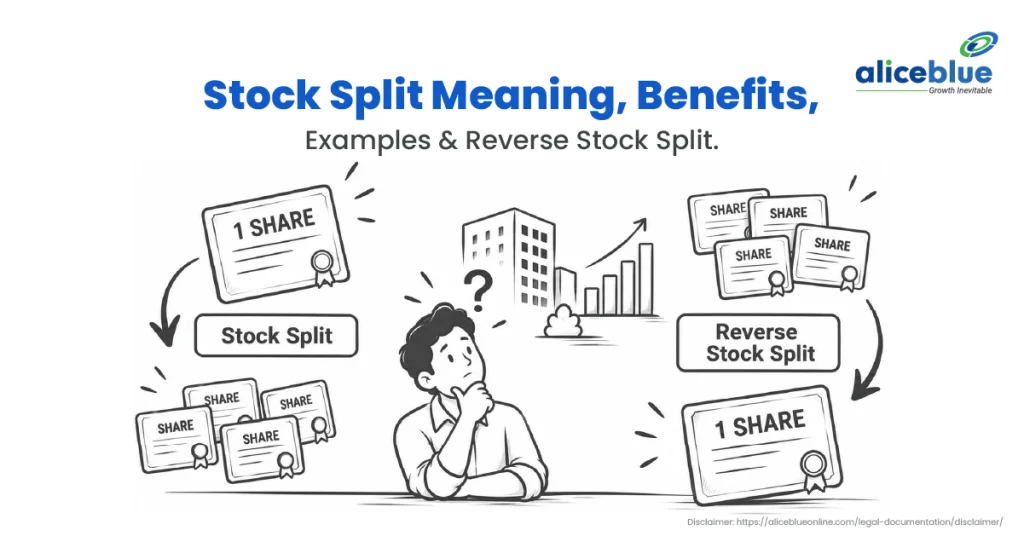
A stock split is when a company issues more shares for each existing share and reduces the price of each share in the same ratio. Your total investment value does not change. For instance, in a 1:5 split, 1 share worth ₹2,000 becomes 5 shares worth ₹400 each, and you still have stock worth ₹2,000. Companies do this to bring down a high share price and make it easier for retail investors to buy. A reverse stock split works the other way. It combines shares to push the price up.
Table of Contents
- What Is a Stock Split
- How Does a Stock Split Work (Step by Step)
- Record Date vs Ex-Date: What Actually Matters
- Practical Example With Numbers
- Key Features of a Stock Split
- Advantages of a Stock Split
- Risks and Limitations
- Tips for Beginners
- Stock Split vs Reverse Split vs Bonus Issue
- Common Mistakes to Avoid
- Who Should Pay Attention to Stock Splits
- Conclusion
- Frequently Asked Questions
Ever opened your demat app and seen a stock price fall by half overnight, with no bad news anywhere? That is usually not a crash. It is a stock split. A stock split happens when a company breaks its existing shares into smaller pieces, so the price per share drops but the number of shares you hold goes up in the same proportion. Your money in the stock stays the same. This guide walks you through what a stock split means, how the whole process works in India, real examples from NSE- and BSE-listed companies, and how a reverse stock split flips the process.
What Is a Stock Split
A stock split is when a company increases the number of shares it has issued by dividing each existing share into multiple shares, without changing the total value of what shareholders own.
Here is a simple way to picture it. If you tear a ₹100 note into two ₹50 notes, you still have ₹100. You just have it in two pieces instead of one. A stock split does the same thing to your shares. If a company announces a 1:2 split, one share becomes two, and the price of each one is cut in half.
Companies usually go for a split when the stock price has climbed so high that many small investors cannot afford even one share. Splitting the stock brings the price down without changing what the company is actually worth. The face value of the share, the original value printed on the share certificate, separate from its market price, also comes down in the same ratio.
How Does a Stock Split Work
Here is what actually happens between the day a company announces a split and the day new shares land in your account:
- Board approval: The company board decides on a split ratio, 1:2, 1:5, or 1:10, usually to lower the share price or improve how actively the stock trades.
- Shareholder approval: The company informs NSE and BSE and, in most cases, gets shareholder sign-off through an AGM or postal ballot.
- Record date is fixed: This is the cut-off date. Your name must be on the company shareholder list on this date to get the extra shares.
- Ex-split date: This is the date the stock actually starts trading at the new, lower price. In India, the ex-date usually falls one trading day before the record date because of T+1 settlement. So you need to buy the stock on or before the ex-date, not the record date, to qualify.
- Shares credited automatically: You do not apply for anything. Your depository, CDSL or NSDL, credits the extra shares to your demat account on its own, based on the split ratio.
- Price and face value adjust together: The market price and face value both change in the same ratio, so your total investment value stays the same right after the split.
The math behind it is straightforward:
New number of shares = Old number of shares × Split ratio
New share price = Old share price ÷ Split ratio
Record Date vs Ex-Date: What Actually Matters
This is where most beginners get confused, and it is one of the most searched questions on this topic. The record date is the date the company uses to check its shareholder list. The ex-date is the date from which the stock trades at the split-adjusted price on the exchange.
Because Indian markets settle trades on a T+1 basis, the ex-date is typically one trading day before the record date. That means if you buy the stock on the ex-date or after, you will not get the split shares. You need to hold it before that date. If you are placing an order close to a split announcement, check the exact ex-date on the NSE or BSE corporate action page. Do not assume the record date is the cut-off for buying.
Practical Example With Numbers
Say you own 10 shares of a company called XYZ Ltd, trading at ₹2,000 each. Your total investment is:
10 shares × ₹2,000 = ₹20,000
XYZ Ltd now announces a 1:5 stock split. One share becomes five. Here is what changes:
| Before Split | After 1:5 Split | |
| Number of shares | 10 | 50 |
| Price per share | ₹2,000 | ₹400 |
| Total value | ₹20,000 | ₹20,000 |
| Face value | ₹10 | ₹2 |
Nothing about your wealth has moved. Only the number of shares and the price per share have adjusted. This is exactly the kind of change seen in real Indian stocks:
- Hindustan Aeronautics Limited (HAL) did a 1:2 split in 2023, cutting face value from ₹10 to ₹5. The ex-split date was September 28, 2023.
- IRCTC did a 1:5 split in October 2021, taking face value from ₹10 to ₹2. The ex-split date was October 28, 2021.
- Adani Power did a 1:5 split in September 2025, taking face value from ₹10 to ₹2.
Rule of thumb: In India, a 1:5 split usually takes face value from ₹10 to ₹2, and a 1:10 split takes it from ₹10 to ₹1. Checking the new face value on the exchange filing is a quick way to confirm the split ratio matches what was announced.
Key Features of a Stock Split
Fundamentals stay untouched: A split does not change the company’s revenue, profit, or assets. It only changes how ownership is divided into units.
Market value does not move: Since the price falls and the share count rises by the same factor, the company’s overall market value stays the same on split day.
Face value drops with the ratio: The nominal value of the share reduces in line with the split.
No action needed from you: Shares are credited automatically to your demat account. There is no form to fill out or request to raise.
Always expressed as a ratio: You will see it written as 1:2, 1:5, or 1:10, showing how one old share turns into new ones.
Applies to every shareholder equally: Anyone holding the stock as of the record date gets the same proportional increase in shares.
Advantages of a Stock Split
- Easier to afford: A lower share price lets small investors buy round lots or build a position without needing a large amount of money upfront.
- More active trading: More shares in circulation at a lower price often pushes up trading volumes, making it easier to buy or sell without moving the price much.
- Wider investor base: An affordable price tends to pull in more retail buyers, which can improve depth on the order book for that stock.
- Often follows good performance: Companies usually split their stock after a strong price run-up, so a split can hint that the business has done well, though it is not a promise of future gains.
- Finer control while investing: With more shares available at a lower price, you get more flexibility when sizing your position in a portfolio.
Risks and Limitations
- No real value is created: A split does not make the company more profitable. Your investment amount is identical before and after.
- The it looks cheap trap: Many new investors believe that the lower share price means the stock is cheap and buy more without verifying that the business itself is doing well.
- Short-term price volatility: Certain stocks show short-term volatility around the split date just because of increased trading activity.
- Not a signal for future growth: A split in the past does not say anything about where the price goes next. Some split stocks have gone on to underperform.
- Confusing cost tracking – If you do not update your average buying price after a split, you can end up with the wrong profit or loss figure when filing capital gains tax.
Tips for Beginners
- Do not buy a stock just because it split or is about to split. Look at earnings, debt, and growth first.
- Update your average buying price after a split. Your cost per share adjusts in the same ratio as the split.
- Check the exact ex-date, not just the record date, so you know when you needed to hold the stock to qualify.
- Compare valuation metrics like P/E before and after the split instead of judging the stock by its new, lower sticker price.
- Use a demat and trading account that shows your corporate action history clearly, so you can match split adjustments against your contract notes.
Stock Split vs Reverse Split vs Bonus Issue
A reverse stock split does the opposite of a regular split. Instead of dividing shares to bring the price down, it combines shares to push the price up. Companies typically use this when the stock price has fallen so low that it risks being tagged a penny stock, or when they want to change how the market perceives the stock.
For a retail investor, seeing a reverse split is usually a signal to be cautious, not a reason to celebrate. It often means the price had dropped so much that the company wanted to fix the number on screen. It does not fix the underlying business. Before buying into a stock that has gone through a reverse split, check its recent profits, debt levels, and cash flow rather than assuming the price bump means recovery.
Recent examples from India:
- Vertoz carried out a 10:1 reverse split in June 2025. Ten shares of face value ₹1 were consolidated into 1 share of face value ₹10.
- Caspian Corporate Services did a 10:1 reverse split with a record date of December 29, 2025. Ten shares of ₹1 face value were converted into 1 share of ₹10 face value.
- Synthiko Foils completed a 2:1 reverse split in October 2025. Two shares of face value ₹5 were consolidated into 1 share of face value ₹10.
A bonus issue is a different corporate action altogether. The company gives you extra shares for free from its reserves, without changing the face value of your existing shares. A split, by contrast, always changes the face value. Both increase your total share count, but they work through different accounting routes and affect your cost basis differently.
| Parameter | Stock Split | Reverse Split | Bonus Issue |
| Share count | Increases | Decreases | Increases |
| Share price | Decreases | Increases | Decreases |
| Face value | Reduces | Increases | Stays the same |
| Common reason | High share price, improve affordability | Very low share price, avoid penny-stock tag | Reward shareholders using reserves |
| Investment value | Unchanged | Unchanged | Unchanged, plus free shares |
| Investor read | Usually a positive sign | Often a caution sign | Usually a positive sign |
Common Mistakes to Avoid
- Buying only because of a split announcement: A split tells you nothing about whether the company is worth investing in. Check the business separately.
- Assuming every reverse split means trouble: Most reverse splits do follow weak stock performance, but some are genuine restructuring moves. Check the latest financials before deciding.
- Missing the ex-date: If you buy after the ex-date expecting the split shares, you will not get them. Always confirm the exact date from the exchange filing.
- Mixing up splits and bonus issues: A bonus issue changes your share count without touching face value. A split changes both. Treating them as the same thing throws off your calculations.
- Forgetting to adjust cost price: Not updating your average purchase price after a split leads to wrong profit or loss numbers, especially at tax time.
Who Should Pay Attention to Stock Splits
Stock splits matter most to long-term investors and swing traders who care about a stock’s affordability and liquidity over time. If you are building a position gradually in a high-priced, fundamentally strong company, a split makes it easier to add shares in smaller amounts.
Intraday traders may benefit from the extra liquidity around a split, but should not treat the split itself as a trading signal. If you are new to the market and exploring IPOs and mutual funds through Alice Blue, treat a stock split as one small piece of information about a company, not a reason to invest on its own.
Conclusion
A stock split changes how many shares you hold and their price, without changing what your investment is worth. Companies use it to make a high-priced stock more affordable and improve trading activity, while a reverse split does the opposite by combining shares to lift a low price. Before buying a stock just because it split, pull up its latest quarterly results, check whether profit is growing, and see if debt is under control. The split itself does not make the stock a buy.
Frequently Asked Questions
1. Does a stock split increase my wealth?
No. A split only changes the number of shares and price per share in the same proportion. Your total investment value stays the same right after the split.
2. Why do companies announce a stock split?
Usually because the share price has grown too high for small investors to buy easily. It also tends to increase how actively the stock trades by putting more shares into circulation.
3. Is a stock split good or bad for investors?
A split by itself is neither good nor bad, since it does not change the company fundamentals. It can be a mild positive sign when it follows real business growth, but the company’s actual performance matters far more than the split.
4. What is the difference between a stock split and a bonus share?
A split divides existing shares and lowers the face value. A bonus issue gives you free additional shares from the company reserves without touching the face value. Both raise your share count, but through different routes.
5. Why would a company do a reverse stock split?
Usually because its share price has dropped so low that it risks being seen as a penny stock, or the company wants to reset how the market views the stock’s stability. It is often, though not always, a warning sign.
6. Can I lose money because of a stock split?
Not from the split itself. Your investment value stays the same. Any loss comes from actual changes in the company’s business or the wider market after the split, not the split mechanism.
7. How do I know if a stock is going to split
?Companies must file split announcements with NSE and BSE, along with the record date and ex-date. You can track these through exchange filings, brokerage split calendars, or financial news platforms.