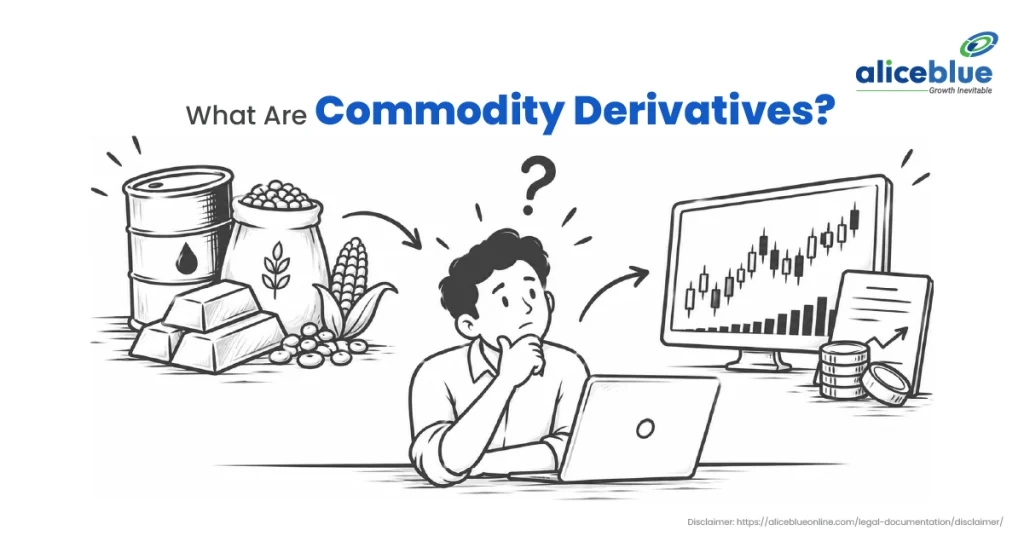
You see gold prices move every day on your phone. You hear friends talk about crude oil or silver. But you do not buy physical gold bars or oil drums. Still, many people trade these prices and make or lose money. They do it using commodity derivatives.
A commodity derivative is a contract. Its price depends on a physical thing like gold, silver, crude oil, or farm products. In India, you mostly see these as futures and options on MCX and NCDEX.
This guide explains what commodity derivatives are, how they work in India, and how a beginner can start trading them without getting lost in jargon.
Quick Answer
Commodity derivatives are contracts that derive their value from the price of a physical commodity such as gold, crude oil, or soybeans. In India, they are primarily traded as futures and options on MCX and NCDEX. Traders use them to speculate on price movements. Businesses use them to lock in prices and reduce risk.
Table of Contents
- What Is a Commodity Derivative?
- What Are Commodity Derivatives?
- How Commodity Derivatives Work (Step by Step)
- Commodity Trading Charges and Tax in India
- Practical Example With Numbers (MCX Gold Futures)
- Key Features of Commodity Derivatives
- Advantages of Trading Commodity Derivatives
- Risks and Limitations
- Tips for Beginners in Commodity Trading
- How to Start Commodity Trading in India (Step by Step)
- Commodity Futures vs Commodity Options
- Is Commodity Trading Safe for Beginners in India?
- Common Mistakes to Avoid
- Who Should Use Commodity Derivatives?
- Conclusion
- Frequently Asked Questions
What Is a Commodity Derivative?
Think of a simple promise between two people. One says, I will buy 1 kg of gold from you next month at a price we decide today. The other says, I will sell it at that price.
That promise, in a standard form, is a commodity derivative. Its value moves with the price of gold, crude, soybeans, or some other physical commodity.
In the market, you do not exchange physical gold. You exchange a contract that tracks the gold price. Traders use these contracts to take positions on price moves. Businesses use them to protect themselves from big price swings.
What Are Commodity Derivatives?
Commodity derivatives are contracts to buy or sell a specific amount of a commodity at a specific price on a future date.
In India, you mainly see two types:
Futures
You agree to buy or sell at a future date at a price decided today. Both sides must honour the contract at expiry.
Options
You get a right, but not an obligation, to buy or sell before expiry. The buyer pays a premium for this right. The seller collects the premium and takes on the obligation.
These contracts trade on SEBI-regulated exchanges:
- MCX (Multi Commodity Exchange)
Mostly metals like gold, silver, copper, and energy like crude oil and natural gas. - NCDEX (National Commodity and Derivatives Exchange)
Mostly agricultural products like soybean, chana, and spices.
Two broad groups use these contracts:
- Traders and speculators
They want to profit from price moves. They do not plan to take or give delivery. - Hedgers
Farmers, jewellers, importers, and manufacturers. They use these contracts to lock in prices and reduce business risk.
How Commodity Derivatives Work (Step-by-Step)
- Choose the commodity
Pick what you want to trade: gold, silver, crude oil, copper, soybean, etc. Each commodity behaves differently. Gold reacts to global cues and currency. Crude reacts to geopolitics and inventories. Agri commodities react to monsoon and crop reports. - Select the contract (futures or options)
Choose a futures or options contract with a specific expiry month and lot size. For example, MCX Gold futures usually have a 1 kg lot size. - Check the quoted price
Prices are quoted per unit.- Gold: per 10 grams
- Crude oil: per barrel
- Silver: per 1 kg
Always check the unit before you calculate anything.
- Calculate contract value
Multiply the quoted price by the contract multiplier. For MCX Gold:
Contract Value = Price per 10g × 100. Why 100? Because 1 kg = 1,000 grams and the quote is for 10 grams. So 1,000 / 10 = 100. This gives you the value of the full 1 kg contract. - Pay margin (not full value)
You do not pay the full contract value. You only pay a margin. This is a small percentage of the contract value, set by the exchange and your broker. For gold futures, this is often between 5 and 12 percent of contract value, depending on price and market conditions. During volatile periods, exchanges can raise margins for a short time. This margin is what creates leverage. A small price move can mean a big percentage move on your margin. - Daily profit and loss (Mark to Market)
Every day, your position is revalued at the closing price. Your profit or loss is settled in cash in your trading account. This is called mark-to-market or MTM. If you make a profit, it is credited. If you make a loss, it is debited. - Exit or hold till expiry
Most retail traders close their position before expiry. They do not wait for delivery. If you hold till expiry, the contract is settled in cash or by delivery, depending on the contract and your broker’s rules. In practice, almost all small traders square off before expiry and never take or give physical delivery. MCX has day and evening trading sessions. Timings vary by commodity. Futures contracts usually expire every month. The closest expiry is called the near-month contract. If you want to stay invested beyond expiry, you roll your position to the next-month contract.
Commodity Trading Charges and Tax in India
Every trade has costs. In commodity derivatives, you usually pay:
- Exchange transaction charges
- Clearing charges
- Brokerage and GST
- Commodity Transaction Tax (CTT) on the sell side for non-agricultural commodity futures
CTT is 0.01 percent of the transaction value on the sell side for non-agricultural commodity futures. Agricultural commodity futures are exempt from CTT.
Brokers may charge a flat fee per order or a percentage of turnover. Check your broker’s tariff so there are no surprises.
Profits from non-hedging commodity trades are usually taxed as non-speculative business income as per your income slab. CTT and other charges can be claimed as expenses. Rules can change, so check the latest schedule on your broker’s website or the exchange before you file.
Practical Example With Numbers (MCX Gold Futures)
Let us walk through a real-style example with MCX Gold.
Assume MCX Gold is quoted at ₹78,000 per 10 grams.
- Lot size = 1 kg = 1,000 grams = 100 × 10g
- Contract value = ₹78,000 × 100 = ₹78,00,000
- Margin required (assume 10 percent) = ₹7,80,000
You buy 1 lot of Gold futures at ₹78,000 per 10g.
If gold rises to ₹79,000 per 10g
Profit = (79,000 – 78,000) × 100 = ₹1,00,000
If gold falls to ₹77,000 per 10g
Loss = (78,000 – 77,000) × 100 = ₹1,00,000
A move of ₹1,000 per 10 grams creates a ₹1 lakh swing on 1 lot. Your margin was around ₹7.8 lakh. So a small price change gives a large percentage move on your capital. This is leverage in action. It can work for you or against you.
Key Features of Commodity Derivatives
- Standardised contracts
Quantity, quality, and expiry are fixed by the exchange. Everyone trades the same contract. This makes prices comparable and liquid. - Leverage
You control a large contract value with a small margin. This increases both profit and loss potential. - Daily settlement
Profit and loss are settled in cash every day through MTM. You see your P&L reflected in your account daily. - Regulated exchanges
MCX and NCDEX are regulated by SEBI. This adds a layer of safety, transparency, and standardisation. - Cash or physical settlement
Most retail traders square off before expiry. Delivery is possible but needs extra arrangements and is rarely used by small traders.
Advantages of Trading Commodity Derivatives
- Hedging for businesses
A farmer can lock in a crop price before harvest. A jeweller can fix gold cost for future orders. An importer can manage crude or metal prices. This reduces uncertainty in their business. - Diversification beyond stocks
Commodities often move differently from equities. Adding them can reduce overall portfolio risk. - Good liquidity in key contracts
Gold, silver, and crude oil on MCX have high trading volumes. Entry and exit are usually easy during market hours. - Lower capital than buying physical
You get exposure to a large quantity of a commodity by paying only margin, not the full value. - Transparent price discovery
Exchange prices reflect what buyers and sellers expect for future prices. This helps everyone make informed decisions.
Risks and Limitations
- High volatility
Commodity prices can swing sharply due to global events, weather, supply shocks, or currency moves. Gold can jump on rate cut hopes. Crude can fall on demand fears. Agri can move on monsoon data. - Leverage can magnify losses
The same leverage that boosts profits can also increase losses quickly if the market moves against you. A small adverse move can wipe out a large part of your margin. - No passive income
Unlike stocks, commodities do not pay dividends or interest. Your return depends only on price changes. - Global factors matter
USD strength, crude inventories, monsoon data, and geopolitical tensions can all impact prices. You need to track these cues. - Active monitoring needed
Successful commodity trading needs discipline, risk control, and regular tracking of positions and news. It is not a set-and-forget game.
Tips for Beginners in Commodity Trading
If you are learning how to start commodity trading in India, keep these points in mind:
- Start with one or two commodities
Focus on gold or crude first. Learn their behaviour before adding silver, copper, or agri commodities. - Use small positions initially
Begin with 1 lot to understand price moves, MTM, and margin usage. Do not jump into multiple lots on day one. - Set a stop loss for every trade
Decide your maximum loss per trade before entering. Stick to it. This protects your capital from big adverse moves. - Avoid using full margin
Keep some free cash in your account to handle MTM swings. Over-leverage is a common reason for quick blow-ups. - Learn expiry and settlement rules
Know the expiry date, time, and settlement type (cash or delivery) for each contract you trade. - Practice before going live
Use paper trading or small-size trades to test your understanding before committing large capital.
How to Start Commodity Trading in India (Step-by-Step)
If you are wondering how to start commodity trading in India, follow these basic steps:
- Choose a SEBI-registered broker
Pick a broker that offers MCX and NCDEX trading, with clear charges and a stable platform. Compare brokerage, platform, and support. - Open a trading and Demat account
Complete your KYC with PAN, Aadhaar, bank details, and income proof if needed. This is similar to opening an equity trading account. - Activate the commodity segment
Request your broker to enable commodity derivatives trading. This usually takes 24 to 48 hours. Some brokers do it online in a few clicks. - Fund your account
Transfer enough money to meet margin requirements for the commodity you want to trade. For example, gold or crude. Keep some extra buffer for MTM swings. - Learn contract specifications
Before placing any trade, check lot size, expiry date, tick size, and market timings for that contract. Do not trade a contract you do not understand. - Start with one liquid commodity
Begin with 1 lot of a liquid contract like MCX Gold or Crude Oil. Avoid jumping into multiple commodities at once. - Place your first order with a plan
Decide your entry, target, and stop loss. Use limit or stop-loss orders instead of only market orders. Write down your plan before you click buy or sell. - Monitor and exit before expiry
Track your position during market hours and square off before expiry unless you fully understand settlement and delivery rules. Most beginners should always exit before expiry.
Commodity Futures vs Commodity Options
| Parameter | Futures | Options |
| Obligation | Both buyer and seller must fulfil the contract at expiry. | Buyer has a right. Seller has an obligation. |
| Upfront cost | Margin only (no premium). | Buyer pays a premium. Seller collects premium and gives margin. |
| Risk for buyer | Unlimited on both sides (price can move a lot). | Limited to the premium paid. |
| Risk for seller | Unlimited. | Unlimited (if price moves sharply against them). |
| Best for | Clear directional view, hedging with simple structure. | Hedging or view with limited risk for the buyer. |
| Complexity | Lower. Easy to understand for beginners. | Higher. You need to understand strike price, expiry, and premium. |
Important note for India: Commodity options are options on futures contracts. If you exercise your option, it becomes a futures position in your account, not a physical commodity position.
Is Commodity Trading Safe for Beginners in India?
Commodity trading can be suitable for beginners if they approach it with the right mindset.
It can work for you if:
- You are ready to learn basics like lot size, margin, and MTM.
- You can accept volatility and occasional losses.
- You follow strict risk control and do not overtrade.
It may not suit you if:
- You want guaranteed returns or very low risk.
- You cannot monitor positions regularly.
- You are uncomfortable with leverage and daily profit and loss swings.
Common Mistakes to Avoid
- Ignoring margin calls and MTM losses
Not keeping enough funds for daily settlement can lead to auto square-off of your position at a loss. Always maintain a buffer. - Overtrading and taking too many positions
Trading too many lots or too many commodities increases risk and costs. Focus on quality setups, not quantity. - Chasing prices after big moves
Entering after a sharp rally or fall often leads to buying at the top or selling at the bottom. Wait for a clear plan and level. - Not understanding expiry and delivery
Holding till expiry without knowing settlement rules can create unwanted delivery obligations or cash settlement surprises. - Trading without tracking global cues
Ignoring USD moves, crude inventories, monsoon data, or global demand and supply reports can make your trades feel like guesses.
Who Should Use Commodity Derivatives?
- Active traders who are comfortable with volatility, leverage, and daily monitoring.
- Businesses and hedgers such as farmers, jewellers, importers, and manufacturers who face commodity price risk.
- Investors looking for diversification beyond stocks and bonds, who understand the risks.
Less suitable for:
- Very conservative investors who cannot tolerate large swings.
- People who cannot track positions or news regularly.
- Anyone uncomfortable with leverage and the possibility of quick losses.
If you fit the first group and have completed your learning, you can consider opening a trading account with Alice Blue and activating the MCX and NCDEX segment to start small.
Conclusion
Commodity derivatives let you trade or hedge exposure to assets like gold, crude oil, and farm products without handling the physical goods. In India, they trade as standardised futures and options on MCX and NCDEX. They can help diversify your portfolio and hedge business risk, but you must be comfortable with sharp price swings and leverage. For beginners, the key is to start small, understand contract specs and charges, and always prioritise risk control. If you use them with discipline and respect the risks, commodity derivatives can sit comfortably alongside your equity and debt investments.
Frequently Asked Questions
1. What are commodity derivatives in simple words?
Commodity derivatives are contracts whose value depends on the price of a physical commodity like gold, crude oil, or soybeans. They help traders speculate on price moves and help businesses reduce price risk.
2. Are commodity derivatives safe for beginners?
They can be used safely if you understand leverage, margin, and volatility. Start with small positions, learn contract specs, and use strict stop losses before trading with larger size.
3. Which exchange is best for commodity trading in India?
MCX is the largest exchange for metals and energy commodities like gold, silver, and crude oil. NCDEX focuses on agricultural commodities like soybean and chana. Both are regulated by SEBI.
4. Do I need to take delivery in commodity futures?
No. As mentioned earlier, most retail traders square off before expiry. Delivery is optional and requires extra arrangements, so beginners usually avoid holding till expiry.
5. How much money do I need to start commodity trading?
You need enough for margin (often 5 to 12 percent of contract value) plus a buffer for daily MTM. For example, 1 lot of MCX Gold can require around ₹7 to ₹8 lakh margin depending on the price and broker.
6. Can I trade commodities along with stocks?
Yes. Many brokers allow a single trading account for equity and commodity segments. You just need to activate the commodity segment with your broker before trading on MCX or NCDEX.
7. What is the difference between commodity futures and options?
Futures create an obligation to buy or sell at expiry. Options give the buyer a right but not an obligation in exchange for a premium. In India, commodity options are options on futures contracts.
Disclaimer: The above article is written for educational purposes and the companies’ data mentioned in the article may change with respect to time. The securities quoted are exemplary and are not recommendatory.