
Every F&O trader hits this situation at some point. Nifty is looking weak, the chart shows a clean breakdown, and you want to take a short position. But buying a plain put feels expensive, especially when India VIX is elevated. You pay a fat premium, the market drifts sideways for three days, and theta quietly eats into your position before any real move happens.
The bear put spread solves this specific problem. It is a two-leg options strategy designed for traders who expect a moderate fall in the market and want to take that position at a lower cost, with a clearly defined maximum loss. This article explains how it works, shows a verified payoff chart, and breaks down the trade in a way beginner traders in India can follow.
A bear put spread is a bearish options strategy where you buy a put option at a higher strike price and sell a put option at a lower strike price on the same underlying asset and the same expiry date.
The put you buy is your main position. It gains value as the market falls. The put you sell at a lower strike brings in some premium, which reduces what you pay upfront. The result is a net debit trade. You pay less than buying a standalone put, but your profit is capped at the lower strike you sold.
This strategy is also called a vertical put spread or a net debit spread. It is widely used on Nifty and Bank Nifty weekly and monthly contracts on NSE. Before using this strategy, it helps to have a clear understanding of how options work. If you are new to options, read Options Trading: Meaning, Example, and Strategies on Alice Blue first.
The trade has two legs. Both must be placed at the same time as a spread order. Never place one leg and wait to place the other, because that exposes you to unnecessary market risk.
You buy a put at the higher strike. This strike is usually close to the current market price, either at the money or slightly in the money. This put has a higher delta, so it reacts more directly to a fall in Nifty.
You sell a put at the lower strike. This strike should sit near your downside target. Selling this put brings in a premium that offsets your cost. It also caps your profit. Once the market reaches this level, your gains stop growing even if the fall continues.
The key formulas are:
The payoff is simple. Between your breakeven point and the lower strike, profit grows as Nifty falls. Once Nifty falls to or below the lower strike, profit stays flat at the maximum. Above the higher strike, both puts expire worthless, and you lose the full net premium paid.
The chart below shows the profit and loss at expiry for the Nifty 24300/24000 Bear Put Spread, based on the verified lot size of 65 units
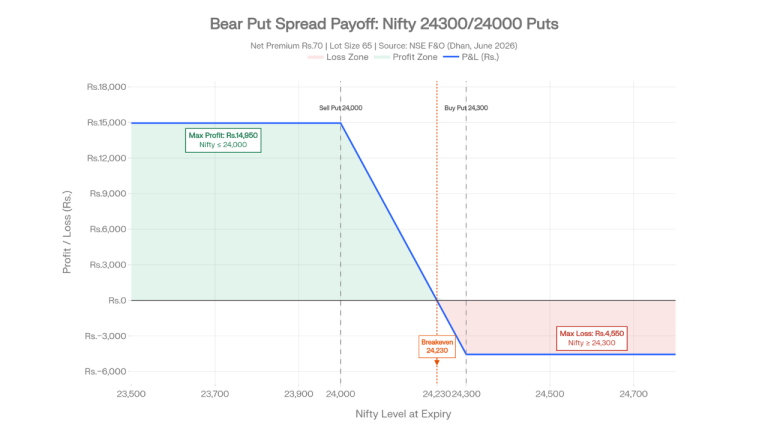
The P&L line is flat to the right of the 24,300 strike, so the market rising further does not increase your loss beyond Rs. 4,550. Between 24,000 and 24,300, the line slopes as Nifty moves, which is the live zone where the trade is directionally sensitive. The P&L line goes flat again to the left of 24,000, so even if Nifty crashes to 23,500, your profit stays capped at Rs. 14,950.
Suppose Nifty is trading at 24,300 ahead of the Union Budget announcement. Markets are nervous, the index has rejected the 24,600 resistance twice in the last week, and you expect a pullback toward 24,000 before Budget day.
Current Nifty lot size: 65 units
Trade Leg | Action | Strike | Premium |
Nifty Put | Buy | 24,300 | Rs. 150 |
Nifty Put | Sell | 24,000 | Rs. 80 |
Net Premium Paid | Rs. 70 |
With a lot size of 65:
Calculation | Value |
Total cost to enter | Rs. 70 x 65 = Rs. 4,550 |
Breakeven | 24,300 minus 70 = 24,230 |
Maximum profit | 300 minus 70 = 230 points, or Rs. 14,950 |
Maximum loss | Rs. 70 x 65 = Rs. 4,550 |
Risk to reward ratio: 1:3.29
What Happens at Expiry
Nifty Closes At | Outcome |
Above 24,300 | Full loss of Rs. 4,550 |
At 24,230 | Breakeven, no profit or loss |
Between 24,000 and 24,230 | Partial profit |
At or below 24,000 | Maximum profit of Rs. 14,950 |
This part matters more than most beginners realise.
When India VIX is elevated, option premiums rise. That means the higher strike put costs more, but the lower strike put also brings in more premium. The two effects partly cancel each other out, which makes the bear put spread more cost stable in high IV environments than a naked put. To understand how India VIX directly affects the premiums you pay, read What Is India VIX and How Does It Affect Options Pricing in India? on Alice Blue.
If you enter before a major event and the market stays flat after the event, IV can fall sharply. That is called IV crush. When that happens, your long put loses value faster than your short put, and the trade can lose money even if Nifty barely moves.
The better entry condition is a moderate to slightly elevated IV level, plus a clear technical signal such as a support break, a weak close below a moving average, or repeated rejection at resistance.
Feature | Bear Put Spread | Naked Put |
Entry cost | Lower | Higher |
Maximum loss | Net premium paid | Full premium paid |
Maximum profit | Capped at spread width | Grows as market falls |
Theta impact | Partly reduced | Full impact |
Delta sensitivity | Lower | Higher |
Best used when | Moderate decline expected | Sharp decline expected |
IV sensitivity | Lower | Higher |
Feature | Bear Put Spread | Bear Call Spread |
Options used | Put options | Call options |
Cash flow at entry | Net debit | Net credit |
Profit condition | Market falls below breakeven | Market stays below short call |
Risk | Limited | Limited |
Ideal market condition | Active bearish move | Mild bearish or rangebound |
Delta at entry | Negative | Negative |
The bear call spread earns a premium upfront and can profit even if the market stays flat or dips slightly. The bear put spread is more directional and needs Nifty to actually fall enough to cross breakeven.
This strategy fits traders who have a clear short-term bearish view on Nifty or Bank Nifty and want a fixed risk setup.
It suits beginners moving into F&O from the cash market because the loss is limited. If you are just getting started with options trading in India, a useful starting point is How to Trade Options in India: Step-by-Step Guide for Beginners.
It also helps traders who find outright puts too expensive during high India VIX phases.
It is less suitable for intraday traders, for people expecting a very sharp crash, and for anyone not yet comfortable managing two-leg positions.
Quick decision checklist before entering:
Factor | What to Check |
Market view | Clearly bearish with technical confirmation |
Expected move size | 1 to 4 percent decline |
India VIX | Moderate, not collapsing post-event |
Risk budget | Only the net premium you can afford to lose |
Strike logic | Lower strike near actual support or price target |
The bear put spread works best when you have a clear technical signal, a realistic target, and want to keep risk fixed before entering the trade. It will not generate outsized returns in a sudden crash, but it gives you a measured, cost-efficient way to trade a falling Nifty without paying full naked put premiums.
If you want to start trading options strategies like the bear put spread with low brokerage and fast order execution, Open Your Alice Blue Account Here
You buy a put at a higher strike and sell a put at a lower strike on the same asset and expiry. You pay a net premium upfront and profit if the market falls below breakeven before expiry.
Breakeven equals the higher strike price minus the net premium paid. In the example above, 24,300 minus 70 equals 24,230.
The maximum loss is the net premium paid multiplied by the lot size. If both puts expire worthless, you lose only that amount and nothing more.
Yes. Nifty weekly options on NSE are actively traded and work well for this strategy. Theta decay is faster in the final two days of expiry, so monitor the position from Wednesday onward.
A bear put spread costs money upfront and needs the market to fall to profit. A bear call spread brings in premium upfront and can profit even if the market stays flat.
For a moderate decline of 1 to 3 percent, yes, because it is cheaper. If you expect a sharp fall of 5 percent or more, a naked put can deliver more profit despite the higher cost.
Many traders exit after taking 50 to 70 percent of the maximum profit rather than waiting until expiry.
Attention Investors!
Stock Brokers can accept securities as margin from clients only by way of pledge in the depository system w.e.f. September 1, 2020. Update your mobile number & email Id with your stock broker/depository participant and receive OTP directly from the depository on your email id and/or mobile number to create a pledge. Pay 20% upfront margin of the transaction early to trade in the cash market segment. Investors may please refer to the Exchange’s Frequently Asked Questions (FAQs) issued vide circular reference NSE/INSP/45191 dated July 31, 2020, and NSE/INSP/45534 dated August 31, 2020, and other guidelines issued from time to time in this regard. Check your Securities /MF/ Bonds in the consolidated account statement issued by NSDL/CDSL every month.
Corporate Office: No. 153/2, 3rd Floor, M.R.B.Arcade, Bagalur Main Road, Dwaraka Nagar, Yelahanka, Bengaluru – 560 063, Karnataka.
Registered Office: Old No.56/2 ,New No.58, LIC Nagar, Vinayagar Kovil Street, Erode -8,Tamil Nadu– 638002.
Alice Blue Financial Services (P) Ltd : NSE EQ | NSE FO | NSE CDS-90112 SEBI REG : INZ000156038
Alice Blue Financial Services (P) Ltd : BSE EQ | BSE FO | BSE CD-6670 SEBI REG : INZ000156038
Alice Blue Financial Services (P) Ltd : CDSL DP ID 12085300 DP SEBI REG : IN-DP-364-2018
Alice Blue Financial Services (P) Ltd : MCX-56710 SEBI REG : INZ000156038
We hereby declare that we are doing PRO trading
Procedure to file a complaint on SEBI SCORES : Register on SEBI SCORES 2.0. Mandatory details for filing complaints on SCORES: Name, PAN, Address, Mobile Number, E-mail ID. Benefits: Effective Communication, Speedy redressal of the grievances
Click on the provided link to learn about the process for submitting a complaint on the ODR platform for resolving investor grievances.
Investment in securities markets are subject to market risks, read all the related documents carefully before investing. Brokerage will not exceed SEBI prescribed limit.
For queries regarding account opening or activation, email to [email protected] and for fund updates, email to [email protected]
Disclaimer : Prevent unauthorized transactions in your account. Update your mobile numbers/email IDs with your stock brokers. Receive information of your transactions directly from Exchange on your mobile/email at the end of the day. Issued in the interest of investors. All clients have to update their email id and mobile number with Member : Investor Grievance [email protected]
KYC is a one time exercise while dealing in securities markets – once KYC is done through a SEBI registered intermediary (broker, DP, Mutual Fund etc.), you need not undergo the same process again when you approach another intermediary.
No need to issue cheques by investors while subscribing to an IPO. Just write the bank account number and sign in the application form to authorise your bank to make payment in case of allotment. No worries for refund as the money remains in the investor’s account.
Investors are requested to note that Alice Blue Financial Services Private Limited is permitted to receive money from investor through designated bank accounts only named as Up streaming Client Nodal Bank Account (USCNBA). Alice Blue Financial Services Private Limited is also required to disclose these USCNB accounts to Stock Exchange. Hence, you are requested to use following USCNB accounts only for the purpose of dealings in your trading account with us. The details of these USCNB accounts are also displayed by Stock Exchanges on their website under “Know/ Locate your Stock Broker. Bank Details (Valid UPI FAQ).


