


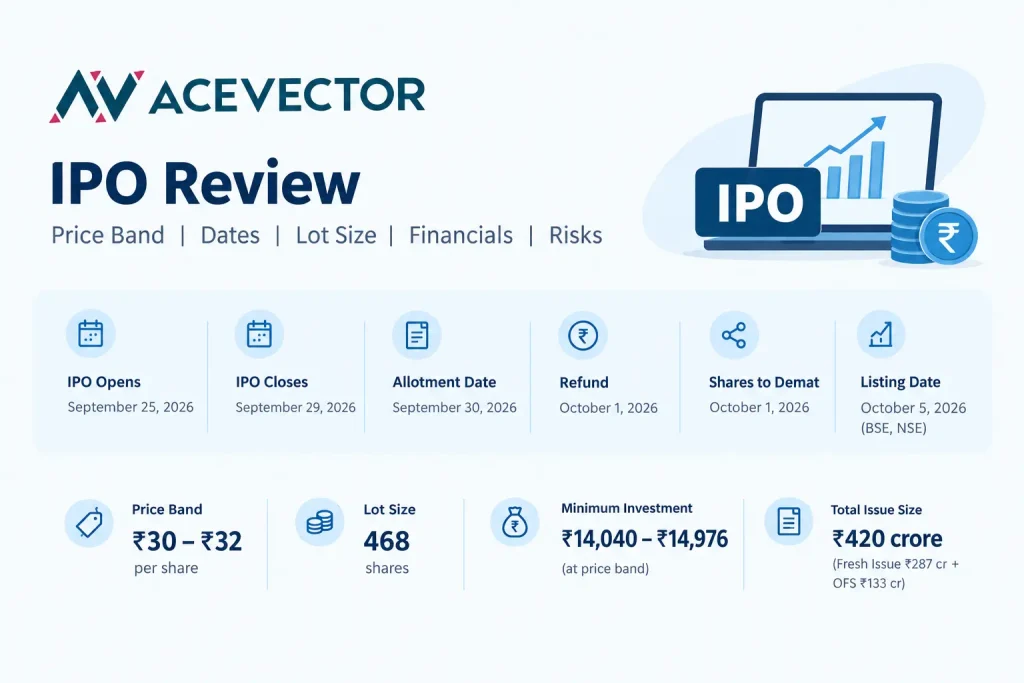




The Acevector IPO opens on September 25 and closes on September 29, 2026. Acevector Limited is a Gurgaon-based digital commerce ecosystem operating an asset-light digital commerce ecosystem through its subsidiaries, spanning data, technology, and AI-driven businesses. Its operations include Snapdeal (value-focused e-commerce marketplace), Uniware, Convertway, and Shipway (e-commerce enablement SaaS platforms), and Stellaro Brands (consumer brand businesses). The company is raising ₹420 crore through a fresh issue of ₹287 crore and an offer for sale of ₹133 crore by existing investors including SoftBank, Nexus Venture Partners and Foxconn.
IPO Snapshot
| Event | Date |
| IPO Opens | September 25, 2026 |
| IPO Closes | September 29, 2026 |
| Allotment Date | September 30, 2026 |
| Refund | October 1, 2026 |
| Shares Credited to Demat | October 1, 2026 |
| Listing Date (BSE, NSE) | October 5, 2026 |
Price Band and Lot Size
| Detail | Value |
| Price Band | ₹30 to ₹32 per share |
| Face Value | ₹1 per share |
| Lot Size | 468 shares |
| Minimum Investment | ₹14,040 to ₹14,976 |
| Retail Maximum | 13 lots, or 6,084 shares (₹1,94,688) |
| Fresh Issue | ₹287 crore (8,96,87,500 shares) |
| Offer for Sale | ₹133 crore (4,15,62,500 shares) |
| Total Issue Size | ₹420 crore |
| Listing | BSE and NSE |
Pre-issue shareholding stood at 45,44,99,270 shares, rising to 54,41,86,770 shares post-issue. The IPO comprises a fresh issue of ₹287 crore and an offer for sale of 4.16 crore shares by existing investors including Starfish I Pte. Ltd. (SoftBank), Nexus India Direct Investments II, FIH Business Global Pte. Ltd. (Foxconn), Nexus Opportunity Fund Ltd., Nexus Ventures III Ltd., and others.
What Does Acevector Actually Do
Acevector Limited, incorporated in 2007, operates an asset-light digital commerce ecosystem through its subsidiaries, spanning data, technology, and AI-driven businesses. Its operations include a value-focused e-commerce marketplace, e-commerce enablement SaaS platforms, and consumer brand businesses.
The ecosystem comprises: (i) Snapdeal, a value-driven lifestyle e-commerce marketplace offering affordable and quality merchandise across lifestyle categories (ii) Uniware, Convertway, and Shipway, providing a comprehensive suite of e-commerce enablement SaaS products that support end-to-end e-commerce operations; and (iii) Stellaro Brands, an omnichannel portfolio of value-focused consumer brands.
In FY 2026, Snapdeal served customers nationwide across 18,972 pin codes in India, primarily catering to middle-income, value-conscious consumers in Tier 2+ and smaller cities, an important segment of the large untapped value e-commerce market.
The company is promoted by Kunal Bahl, Rohit Kumar Bansal, and Starfish I Pte. Ltd. (SoftBank). As of March 31, 2026, the company had a diversified ecosystem driving organic and inorganic growth across businesses with centralised strategy support.
The Money Numbers
| Metric | FY24 | FY25 | FY26 |
| Total Assets (₹ Crore) | 410.50 | 558.09 | 575.28 |
| Total Income (₹ Crore) | 384.74 | 406.77 | 537.67 |
| Profit After Tax (₹ Crore) | -51.30 | -126.31 | -45.51 |
| Net Worth (₹ Crore) | -142.09 | 126.33 | 102.08 |
All numbers are taken from the company’s official IPO document (RHP) and cross-checked with trusted sources.
Total income grew from ₹384.74 crore in FY24 to ₹537.67 crore in FY26, up 39.7% over two years. The company reported losses throughout the period, with PAT improving from a loss of ₹126.31 crore in FY25 to a loss of ₹45.51 crore in FY26, narrowing by 64%. Total assets increased from ₹410.50 crore to ₹575.28 crore, while net worth turned positive from -₹142.09 crore in FY24 to ₹102.08 crore in FY26.
EBITDA loss narrowed from ₹107.79 crore in FY25 to ₹22.17 crore in FY26, up 79.4%. Total borrowings stood at ₹0.45 crore in FY25, with the company being virtually debt-free.
Return ratios were negative: RoNW stood at -59.54%, and NAV was ₹2.21 per share as of March 31, 2026.
Objects of the Issue
| Purpose | Amount (₹ Crore) |
| Funding a portion of the marketing and business promotion expenses of the Marketplace business of the Company | 132.00 |
| Funding the technology infrastructure costs of the Marketplace business of the Company | 50.00 |
| Funding inorganic growth through acquisitions and general corporate purpose | Balance amount |
| Total identified objects | 182.00 |
Strengths
- Revenue growth, with total income increasing 39.7% from FY24 to FY26.
- Significant improvement in profitability, with EBITDA loss narrowing by 79.4% from FY25 to FY26.
- Diversified ecosystem across e-commerce marketplace, SaaS platforms, and consumer brands.
- Leading value-focused e-commerce marketplace purpose-built for value shoppers.
- Pan-India presence across 18,972 pin codes.
- Proprietary technology stack powering discovery-led, personalised shopping experience.
- Robust unit economics with operating leverage in effect.
- Experienced management team with marquee investors including SoftBank, Nexus and Foxconn.
- Virtually debt-free balance sheet.
- Strong net worth turnaround from -₹142.09 crore to ₹102.08 crore.
Risks
- The company reported losses in all three years, with a PAT loss of ₹45.51 crore in FY26.
- EBITDA remained negative at -₹22.17 crore in FY26.
- RoNW was negative at -59.54% as of March 31, 2026.
- The company operates in the highly competitive e-commerce sector with exposure to intense competition from Flipkart, Amazon, Meesho, and other players, along with high customer acquisition costs.
- A significant portion of the fresh-issue proceeds (₹182 crore out of ₹287 crore) is earmarked for marketing and technology expenses, indicating continued high burn rate.
- The company’s expansion depends on securing new customers and maintaining GMV growth.
- The e-commerce sector is subject to regulatory changes and FDI policy restrictions.
- High reliance on promoter and investor funding for growth.
- The offer for sale component means a portion of proceeds will go to selling shareholders and not toward the company’s growth.fortuneindia+1
- Valuation of ~₹1,741 crore at the upper price band may be rich compared to peers given the company is loss-making.
How to Apply
You can apply through Alice Blue by selecting your investor category, choosing the number of lots, and submitting your bid between September 25 and September 29.
If you do not want to track subscription numbers throughout the bidding window, Alice Blue’s IPO feature can apply on your behalf. Choose your category and lot size, confirm your UPI ID, and set a subscription trigger, such as below 1x, between 1x and 5x, or above 5x. The system tracks Acevector’s live subscription numbers and submits the application once the selected condition is met. You then receive a UPI payment request to approve. Funds are not deducted until shares are allotted.
Frequently Asked Questions
What is the price band for the Acevector IPO?
The price band is ₹30 to ₹32 per share.
What is the Acevector IPO lot size?
The lot size is 468 shares. At the upper price band, one lot costs ₹14,976.
What is the minimum investment in the Acevector IPO?
The minimum investment is ₹14,040 at the lower price band and ₹14,976 at the upper price band.
When will the Acevector IPO open and close?
The IPO opens on September 25, 2026, and closes on September 29, 2026.
When will Acevector IPO shares be allotted?
The basis of allotment is expected to be finalised on September 30, 2026.
When will Acevector IPO list?
The tentative listing date is October 5, 2026, on BSE and NSE.






