
You have a full-time job. You know basic trading. But you cannot watch the market every minute, and you find it hard to follow your own rules consistently. This is where 1LyAlgos strategies can help.
1LyAlgos provides two types of pre-built algo trading strategies: Ready to Subscribe strategies and Marketplace strategies. Both are exchange-approved, run automatically, and include risk controls. You can study their past performance before you start. Ready to Subscribe strategies are created by 1LyAlgos and do not carry a strategy subscription fee. Market Place strategies come from external partners and may need capital allocation or a subscription payment as per the provider’s terms.
1LyAlgos offers two types of pre-built algo trading strategies: Ready to Subscribe and Market Place. Ready to Subscribe strategies are built by 1LyAlgos and need only the trading margin. Market Place strategies are listed by external partners and may require capital or a subscription fee. Both types allow backtesting, have built-in risk management, and execute trades in real time.
1LyAlgos strategy types refer to the two ways you can access pre-built, exchange-approved trading strategies on the platform: Ready to Subscribe and Marketplace.
An algo trading strategy is a set of fixed rules that decide when to enter a trade, when to exit, and how much risk to take. In 1LyAlgos, you do not need to write code. You pick a strategy, study its past performance, subscribe to it, and let it trade automatically when its rules match market conditions.
These 1LyAlgos strategies are designed for Indian traders who want to trade in a disciplined way without watching the screen all day. They can be used for intraday trading, swing trading, BTST, STBT, expiry-day trading, and derivatives such as Nifty and Bank Nifty options.
The exact rules differ from one strategy to another. Some use technical indicators, some use price patterns, and some focus on expiry-day behaviour. But the overall flow is similar.
You start by choosing a category that matches your style:
If you have a full-time job, intraday or expiry-day strategies may need more attention during market hours. Swing or BTST strategies may suit you better.
On the 1LyAlgos platform, you can browse the strategy library and click on any strategy that looks interesting. The strategy page shows key details such as:
These details help you understand what you are getting into before you commit any money.
Backtesting means applying the strategy’s rules to past market data to see how it would have performed. A backtest report may show.
A longer backtest with more trades usually gives a better picture than a short one with very few trades. But remember, past performance does not guarantee future results.
Ready to Subscribe strategies need the trading margin specified by the strategy. There is no separate strategy subscription fee for these, as per the reference guide.
Market Place strategies may require a particular capital allocation or subscription payment based on the partner provider’s terms.
You should also keep in mind brokerage, exchange charges, taxes, slippage (difference between expected price and actual trade price), and other costs. These reduce your final profit or increase your loss.
After you are comfortable with the details, you can subscribe to the strategy and maintain the required margin or capital. Once activated, the strategy monitors the market in real time. When its rules are met, it places orders automatically, similar to how you would place a manual trade.
Automated trading does not mean you can ignore your account. You should still:
You can stop the strategy at any time if needed. It is important to understand how open positions are handled when you pause or stop a strategy.
Ready to Subscribe strategies are pre-built, exchange-approved strategies created and maintained directly by 1LyAlgos.
Key points:
These strategies are a good starting point if you want to begin quickly with 1LyAlgos’ own set of rules and risk controls.
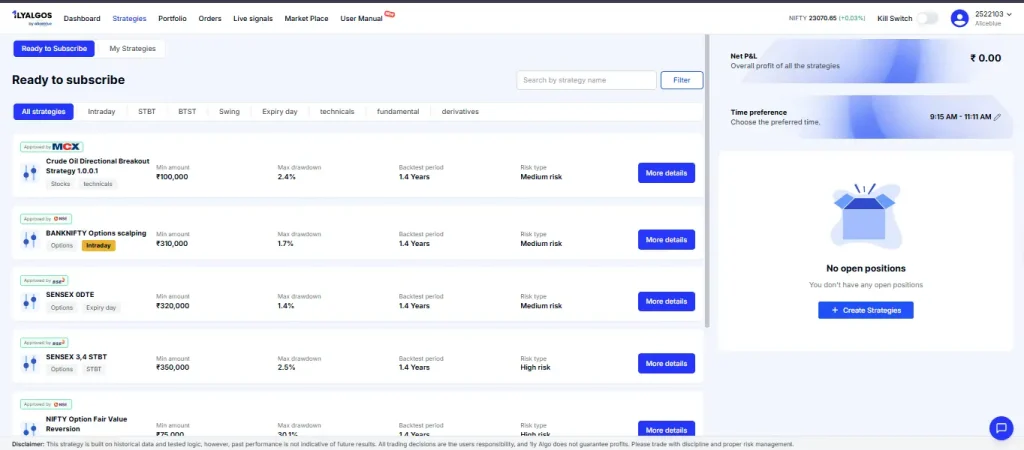
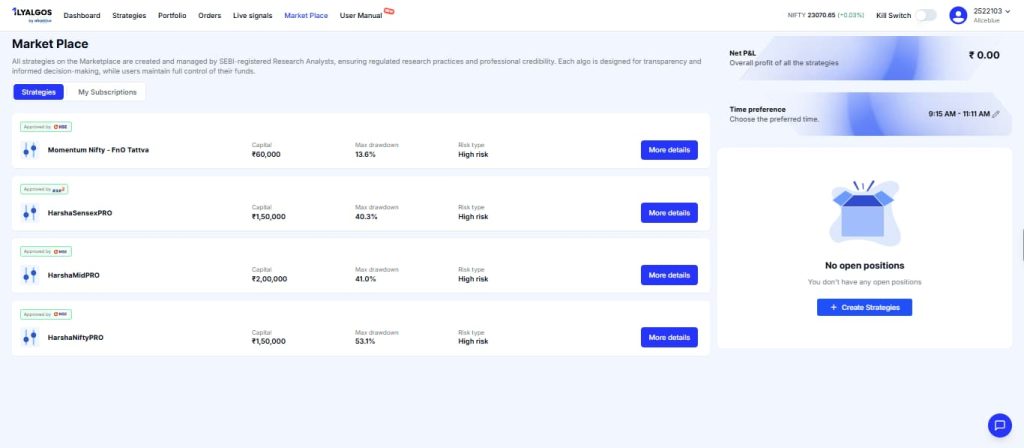
Market Place strategies are also pre-built and exchange-approved, but they are listed by external partner strategy providers on the 1LyAlgos Market Place.
Key points:
These strategies are useful if you want to diversify beyond 1LyAlgos’ own library and explore rules designed by other experienced traders.
If you are new to algo trading strategies in India, follow these simple steps before you pick a strategy:
This approach helps you avoid common beginner mistakes and gives you time to learn how 1LyAlgos strategies work in practice.
Let us assume you are looking at a Ready to Subscribe intraday strategy on Bank Nifty options. The strategy requires a trading margin of ₹60,000.
The backtest shows:
Metric | Historical result |
Backtest period | 2 years |
Number of trades | 260 |
Historical profit | ₹39,000 |
Maximum drawdown | ₹13,000 |
Winning trades | 145 |
Losing trades | 115 |
The average historical profit per trade before costs is:
Average profit per trade= ₹39,000 / 260 ≈ ₹150
The maximum drawdown of ₹13,000 means that at some point in the past, the strategy’s value fell by this amount from a previous high. It does not mean your future loss will be limited to ₹13,000.
Now suppose you activate the strategy with ₹60,000. In one month, the strategy makes a gross profit of ₹3,000. If brokerage, exchange charges, taxes, and slippage together come to around ₹500, your approximate net result before income tax would be:
₹3,000−₹500 = ₹2,500
In another month, the strategy may make a gross loss of ₹4,000. With the same ₹500 in costs, your net loss would be:
₹4,000+₹500 = ₹4,500
This example shows why you must look at both profit and drawdown. Backtest numbers are useful for learning, but live results can be different due to market conditions, execution quality, and costs.
You do not need to watch the market continuously. The strategy monitors price movements and acts when its conditions are met. This can be helpful if you have a job, business, or other commitments.
The strategy follows fixed rules instead of reacting to every small move in the market. This can reduce impulsive entries and exits, though you still need to choose and monitor the strategy carefully.
Backtest reports show how the strategy behaved in different market conditions. Metrics like drawdown, returns, and number of trades help you make a more informed choice.
You can pick from different holding periods and segments. The Market Place also allows you to explore strategies from external providers, which increases your options.
You can access algo trading strategies without building your own system or writing code. This is useful for beginners who want to learn systematic trading first.
A strategy that worked well in the past may not work the same way in the future. Market conditions change, and no backtest can predict every scenario.
Automated trading does not remove market risk. You can lose money due to wrong signals, sudden price moves, gaps, high volatility, or a series of losing trades.
Backtests use assumptions about slippage, liquidity, and order execution. Actual prices can be different, especially in fast-moving or less liquid contracts.
An options strategy may have different risks from an equity swing strategy. Do not select a strategy only by its name or return percentage. Read the details and risk disclosures.
Internet problems, broker connectivity issues, exchange disruptions, order rejection, or insufficient margin can affect execution. Automated systems still need regular monitoring.
Marketplace strategies can have different subscription terms, capital requirements, and risk profiles. Review provider-specific conditions before subscribing.
Parameter | Ready to Subscribe | Market Place |
Strategy source | Created and maintained by 1LyAlgos | Listed by external partner providers |
Exchange approval | Yes, as per the reference guide | Yes, as per the reference guide |
Execution | Real-time automated trading | Real-time automated trading |
Risk management | Built in | Built in |
Backtesting | Available before subscribing | Available before subscribing |
Activation cost | No strategy subscription fee; only trading margin required | Capital allocation or subscription terms set by the partner |
Choice of providers | Platform-native strategies | Strategies from external providers |
Best suited for | Beginners who want to start with 1LyAlgos strategies | Traders who want to explore partner strategies |
The main difference is the source. Ready to Subscribe strategies come from 1LyAlgos. Marketplace strategies come from external partners. Both should be reviewed using the same checks: historical performance, drawdown, capital requirement, risk type, and costs.
A high historical return does not automatically mean the strategy is suitable. Review drawdown, risk type, number of trades, and market conditions first.
Some users focus only on returns and forget to check if they can maintain the required margin. Insufficient margin can lead to order rejection or forced exits.
A backtest is a historical simulation, not a promise. Use it for analysis, not as a guarantee of future profit.
Several strategies may trade the same instrument or respond to the same market move. This can increase concentration and losses.
Automated strategies still require oversight. Check positions, orders, margin, P&L, and system alerts regularly.
Small costs can affect the final result, especially when the strategy places many trades. Include all applicable charges in your review.
A strategy can have losing trades as part of its design. Before stopping it, understand its expected drawdown and risk controls. At the same time, do not continue blindly if the strategy behaves outside its stated limits.
1LyAlgos strategies may suit:
They may be less suitable for people who:
If you are not comfortable with possible losses, first learn about the relevant market segment and risk controls before activating any strategy.
1LyAlgos provides two main types of pre-built algo trading strategies: Ready to Subscribe strategies created by 1LyAlgos and Marketplace strategies listed by external partners. Both offer real-time execution, built-in risk controls, and backtesting access before you start. The key differences are the strategy source, available selection, and subscription or capital terms. Before choosing a strategy, review its risk type, maximum drawdown, historical performance, costs, and margin requirement. Automated execution can support disciplined trading, but it does not remove market risk or guarantee returns. Start small, study the backtest carefully, and monitor your account regularly.
1LyAlgos offers Ready to Subscribe strategies and Market Place strategies. These may cover categories such as intraday, swing, BTST, STBT, expiry-day, technical, fundamental, and derivatives trading.
Ready to Subscribe strategies are pre-built strategies created and maintained by 1LyAlgos. You can review their details, study the backtest, and subscribe by maintaining the required trading margin. There is no strategy subscription fee for these; only the trading margin is needed.
Market Place strategies are pre-built strategies listed by external partner providers. Their capital requirements and subscription terms may vary according to the provider. You should read the provider’s terms before subscribing.
The reference guide states that both Ready to Subscribe and Market Place strategies are exchange approved. You should still read all applicable disclosures, terms, and risk information before activation.
Yes, beginners can use 1LyAlgos strategies because you do not need to write code. But you should first understand the strategy’s instrument, holding period, drawdown, and capital requirement. Automated trading does not remove the risk of loss.
No. 1LyAlgos strategies are pre-built and no-code. You select a strategy, review its backtest, and subscribe. You do not need to program or build your own rules to use these strategies.
Attention Investors!
Stock Brokers can accept securities as margin from clients only by way of pledge in the depository system w.e.f. September 1, 2020. Update your mobile number & email Id with your stock broker/depository participant and receive OTP directly from the depository on your email id and/or mobile number to create a pledge. Pay 20% upfront margin of the transaction early to trade in the cash market segment. Investors may please refer to the Exchange’s Frequently Asked Questions (FAQs) issued vide circular reference NSE/INSP/45191 dated July 31, 2020, and NSE/INSP/45534 dated August 31, 2020, and other guidelines issued from time to time in this regard. Check your Securities /MF/ Bonds in the consolidated account statement issued by NSDL/CDSL every month.
Corporate Office: No. 153/2, 3rd Floor, M.R.B.Arcade, Bagalur Main Road, Dwaraka Nagar, Yelahanka, Bengaluru – 560 063, Karnataka.
Registered Office: Old No.56/2 ,New No.58, LIC Nagar, Vinayagar Kovil Street, Erode -8,Tamil Nadu– 638002.
Alice Blue Financial Services (P) Ltd : NSE EQ | NSE FO | NSE CDS-90112 SEBI REG : INZ000156038
Alice Blue Financial Services (P) Ltd : BSE EQ | BSE FO | BSE CD-6670 SEBI REG : INZ000156038
Alice Blue Financial Services (P) Ltd : CDSL DP ID 12085300 DP SEBI REG : IN-DP-364-2018
Alice Blue Financial Services (P) Ltd : MCX-56710 SEBI REG : INZ000156038
We hereby declare that we are doing PRO trading
Procedure to file a complaint on SEBI SCORES : Register on SEBI SCORES 2.0. Mandatory details for filing complaints on SCORES: Name, PAN, Address, Mobile Number, E-mail ID. Benefits: Effective Communication, Speedy redressal of the grievances
Click on the provided link to learn about the process for submitting a complaint on the ODR platform for resolving investor grievances.
Investment in securities markets are subject to market risks, read all the related documents carefully before investing. Brokerage will not exceed SEBI prescribed limit.
For queries regarding account opening or activation, email to [email protected] and for fund updates, email to [email protected]
Disclaimer : Prevent unauthorized transactions in your account. Update your mobile numbers/email IDs with your stock brokers. Receive information of your transactions directly from Exchange on your mobile/email at the end of the day. Issued in the interest of investors. All clients have to update their email id and mobile number with Member : Investor Grievance [email protected]
KYC is a one time exercise while dealing in securities markets – once KYC is done through a SEBI registered intermediary (broker, DP, Mutual Fund etc.), you need not undergo the same process again when you approach another intermediary.
No need to issue cheques by investors while subscribing to an IPO. Just write the bank account number and sign in the application form to authorise your bank to make payment in case of allotment. No worries for refund as the money remains in the investor’s account.
Investors are requested to note that Alice Blue Financial Services Private Limited is permitted to receive money from investor through designated bank accounts only named as Up streaming Client Nodal Bank Account (USCNBA). Alice Blue Financial Services Private Limited is also required to disclose these USCNB accounts to Stock Exchange. Hence, you are requested to use following USCNB accounts only for the purpose of dealings in your trading account with us. The details of these USCNB accounts are also displayed by Stock Exchanges on their website under “Know/ Locate your Stock Broker. Bank Details (Valid UPI FAQ).


