
You open the chart, spot a perfect move, and before you can click buy, the price shoots up, and you’re left watching, thinking, “I knew that was going to happen.” If that sounds familiar, you’re not alone.
Many traders struggle with timing. The market moves fast, opportunities come and go in seconds, and waiting for the “perfect trade” often means missing it completely. That’s where the 1-minute scalping strategy changes everything.
Instead of chasing big moves, this approach focuses on small, quick profits by getting in and out of trades within minutes using clear, structured signals.
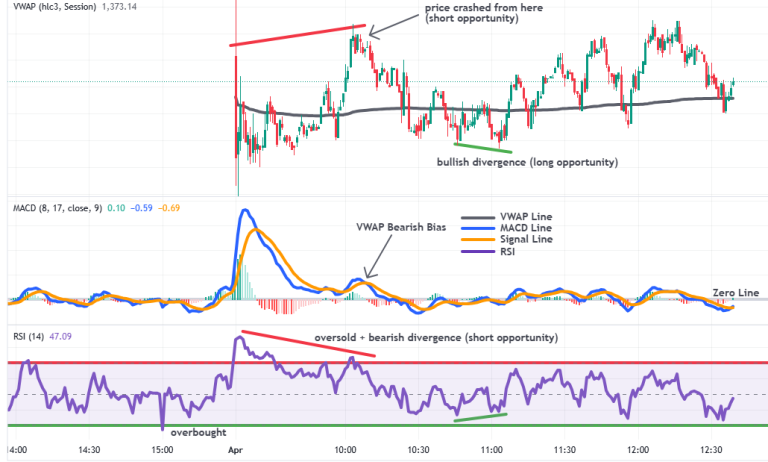
In this guide, you’ll learn how to use VWAP, MACD, and RSI together to spot high-probability setups.
The 1-minute scalping strategy is a short-term trading method where traders enter and exit trades within seconds or minutes using a 1-minute chart. It focuses on capturing small price movements using indicators like VWAP, MACD, and RSI, combined with strict risk management.
Done carelessly, it will lead to rapid losses.
Before jumping into trades, your chart setup should be clean and simple.
1-minute chart
Indicator | Recommended Settings for 1-Min Scalping | Purpose | Best Time Window (India) |
VWAP | Default Daily VWAP (resets at 9:15 AM IST) | Trend Bias (Above = Bullish, Below = Bearish) | 9:30–11:00 AM & 1:30–2:30 PM IST |
MACD | Fast: 8; Slow: 17. Signal: 9 | Momentum Trigger (Crossover + Histogram) | High-volume sessions |
RSI | Period: 7 or 9 (Levels: 30/70) | Overbought/Oversold Filter + Divergence | Morning momentum bursts |
VWAP shows the average price at which the asset has traded throughout the day (since 9:15 AM IST), weighted by volume. Institutions use it as a benchmark.
VWAP resets automatically every day at 9:15 AM, so you always get a fresh line for that trading session.
VWAP works well on futures charts during these hours because institutional algos are heavily VWAP-based.
MACD is a momentum indicator that shows the relationship between two moving averages. It shows the speed of price movement through two lines and a histogram
RSI measures the strength of price movements. It tells when a stock is overbought (time to sell) or oversold (time to buy).
RSI is a momentum indicator that ranges from 0 to 100.
For scalping, RSI is useful for spotting momentum shifts and entry timing.
Hidden Bearish Divergence: Price makes a lower high (during a downtrend rally), but RSI makes a higher high. → The downtrend remains dominant; any rally is weak → Good for selling/short on rallies (continuation downward).
Condition | Long (Buy) Setup | Short (Sell) Setup |
VWAP Bias | Price clearly above VWAP | Price clearly below VWAP |
MACD Signal | The line crosses above signal + Green histogram | The line crosses below signal + Red histogram |
RSI Filter | Above 30 and climbing | Below 70 and falling |
Entry | On candle close | On candle close |
Stop Loss | Below the recent swing low | Above the recent swing high |
Risk-Reward | Minimum 1:1.5 to 1:2 (after costs) | Minimum 1:1.5 to 1:2 (after costs) |
Aspect | Pros | Cons |
Clarity | Very clear, rule-based entries | Requires constant screen time |
Applicability | Works on stocks, futures & options | Spreads, brokerage & STT eat small profits |
Filters | Combines trend + momentum + exhaustion | Emotionally demanding |
Best Conditions | High-volume trending sessions | Poor in sideways or low-volume markets |
This is where most scalpers fail.
Category | Recommendation | Why It Matters |
Risk per Trade | Max 0.5–1% of the account | Protects capital during losing streaks |
Daily Trades | 5–12 high-quality setups only | Prevents over-trading |
Daily Loss Limit | Stop after -2% | Saves you from revenge trading |
Best Sessions | 9:30–11:00 AM IST (highest volume) | Cleanest signals & lower slippage |
Tip: Scalping is fast and emotional. If you feel revenge trading coming, close the platform immediately.
Not all market conditions are suitable for this strategy.
If the market seems unclear, better to stay away than force a trade.
Many beginners struggle with scalping because of these mistakes:
No pre-defined take-profit and skipping stop-loss
Sometimes, the best trade is no trade at all.
The 1-minute scalping strategy is powerful because it combines trend (VWAP), momentum (MACD), and timing (RSI) into a simple system for high-probability ultra-fast trading.
But success doesn’t come from just knowing the strategy; it comes from the following:
Focus on taking high-quality setups while keeping losses small and staying consistent.
To effectively apply these strategies, using a reliable trading platform can help streamline chart analysis and execution. Platforms like Alice Blue ANT offer tools that support indicator-based trading, allowing you to test and refine your approach in real market conditions.
There’s no fixed number, but most professional scalpers limit themselves to 5-12 high-quality trades per day. Taking too many trades usually leads to over-trading and unnecessary losses.
You can start with a small account, but realistically,
The key is not capital size, but proper position sizing and discipline.
They matter a lot. Choose a broker with low brokerage (₹20 or less per order) and tight spreads on futures. Factor in 2-4 points of slippage in your stop-loss and target calculations. If your average winner is 12-15 points, a bad broker can turn a winning strategy into a losing one.
Yes. But it’s not ideal for pure 1-minute scalping, as it requires seeing the “Triple Confirmation” instantly. The charts on mobile are smaller, and candle updates can lag slightly, and switching between indicator views can cost you those vital 3-5 seconds that make or break a scalp.
This is called “overextension”. If the price is miles above the VWAP, do not enter a long trade, even if the MACD is bullish. The price has a “magnetic” relationship with VWAP and will eventually pull back to it. In this scenario, wait for the price to return to the VWAP and consolidate before looking for your next entry.
This is one of the most overlooked parts of 1-minute scalping in India. Since you take many trades for small point gains, the combined cost of brokerage, STT, GST, and other charges can easily eat away 30% to 60% of your gross profits. Especially after the STT hike effective from April 2026. To stay profitable, use a flat-fee brokerage plan (₹20 or less per order) and make sure your average winning trade is large enough.
Leverage can amplify profits, but also losses. Beginners should use low leverage and focus on risk management. High leverage and fast trading are high risk if not controlled properly.
A good platform can make a big difference in execution speed and accuracy, so look for platforms that offer low latency, fast order execution, and advanced charting (like TradingView integration).
However, adding too many indicators can reduce clarity. Try to keep your setup simple and consistent.
This usually happens for a variety of reasons, such as entering late (after the move already started), trading during choppy/low-volume markets, or ignoring overall trend context. Even the best strategy has losing trades. Try to focus on execution consistency and not perfection.
While the logic applies to both, it is generally more accurate for futures because VWAP is calculated using volume, which is more “pure” in the futures market. If you’re scalping options, be mindful of time decay. In a 1-minute window, a stagnant price means your option value is dropping even if the setup remains valid.
To minimise slippage, always use limit orders instead of market orders when possible and only trade assets with a “thin” spread (high liquidity). If the gap between the “buy” and “sell” price is too wide, the trade isn’t worth the risk.
No trade. The strength of the 1-minute scalp strategy lies in the “confluence”. If the MACD crosses but the RSI is flat, it suggests the move lacks internal strength.
It works very well on index options, especially during the first 90 minutes after 9:15 AM. Trade ATM or slightly OTM options with good liquidity. Just remember that time decay works against you, so keep every trade under 8 minutes and never hold overnight.
Most disciplined traders see a 55-65% win rate when they strictly follow the three-indicator rules. Expect 4-8 quality trades per day during high-volume sessions, aiming for 0.8-1.5% net profit on your capital after commissions and slippage. Backtest at least 200 trades before expecting consistent income.
Open TradingView, switch to the 1-minute timeframe on Nifty or Bank Nifty, and add the three indicators with the exact settings mentioned above (MACD 8-17-9, RSI 9 or 14). Scroll back 30-60 trading days and manually mark every setup that met all three rules. Track win/loss, risk-reward, and time of day. This will show the real edge in the Indian market conditions.
For 1-minute scalping in the Indian market, the faster 8-17-9 settings are strongly recommended. The default 12-26-9 is too slow and often misses the quick momentum moves that happen in Nifty and Bank Nifty. Test both on historical data; most traders switch to the faster version within a week.
Attention Investors!
Stock Brokers can accept securities as margin from clients only by way of pledge in the depository system w.e.f. September 1, 2020. Update your mobile number & email Id with your stock broker/depository participant and receive OTP directly from the depository on your email id and/or mobile number to create a pledge. Pay 20% upfront margin of the transaction early to trade in the cash market segment. Investors may please refer to the Exchange’s Frequently Asked Questions (FAQs) issued vide circular reference NSE/INSP/45191 dated July 31, 2020, and NSE/INSP/45534 dated August 31, 2020, and other guidelines issued from time to time in this regard. Check your Securities /MF/ Bonds in the consolidated account statement issued by NSDL/CDSL every month.
Corporate Office: No. 153/2, 3rd Floor, M.R.B.Arcade, Bagalur Main Road, Dwaraka Nagar, Yelahanka, Bengaluru – 560 063, Karnataka.
Registered Office: Old No.56/2 ,New No.58, LIC Nagar, Vinayagar Kovil Street, Erode -8,Tamil Nadu– 638002.
Alice Blue Financial Services (P) Ltd : NSE EQ | NSE FO | NSE CDS-90112 SEBI REG : INZ000156038
Alice Blue Financial Services (P) Ltd : BSE EQ | BSE FO | BSE CD-6670 SEBI REG : INZ000156038
Alice Blue Financial Services (P) Ltd : CDSL DP ID 12085300 DP SEBI REG : IN-DP-364-2018
Alice Blue Financial Services (P) Ltd : MCX-56710 SEBI REG : INZ000156038
We hereby declare that we are doing PRO trading
Procedure to file a complaint on SEBI SCORES : Register on SEBI SCORES 2.0. Mandatory details for filing complaints on SCORES: Name, PAN, Address, Mobile Number, E-mail ID. Benefits: Effective Communication, Speedy redressal of the grievances
Click on the provided link to learn about the process for submitting a complaint on the ODR platform for resolving investor grievances.
Investment in securities markets are subject to market risks, read all the related documents carefully before investing. Brokerage will not exceed SEBI prescribed limit.
For queries regarding account opening or activation, email to [email protected] and for fund updates, email to [email protected]
Disclaimer : Prevent unauthorized transactions in your account. Update your mobile numbers/email IDs with your stock brokers. Receive information of your transactions directly from Exchange on your mobile/email at the end of the day. Issued in the interest of investors. All clients have to update their email id and mobile number with Member : Investor Grievance [email protected]
KYC is a one time exercise while dealing in securities markets – once KYC is done through a SEBI registered intermediary (broker, DP, Mutual Fund etc.), you need not undergo the same process again when you approach another intermediary.
No need to issue cheques by investors while subscribing to an IPO. Just write the bank account number and sign in the application form to authorise your bank to make payment in case of allotment. No worries for refund as the money remains in the investor’s account.
Investors are requested to note that Alice Blue Financial Services Private Limited is permitted to receive money from investor through designated bank accounts only named as Up streaming Client Nodal Bank Account (USCNBA). Alice Blue Financial Services Private Limited is also required to disclose these USCNB accounts to Stock Exchange. Hence, you are requested to use following USCNB accounts only for the purpose of dealings in your trading account with us. The details of these USCNB accounts are also displayed by Stock Exchanges on their website under “Know/ Locate your Stock Broker. Bank Details (Valid UPI FAQ).


